
How to go off Lexapro safely
Lexapro is an antidepressant medication that is one of the most commonly prescribed medications in the US. Like other antidepressant medications, it can cause uncomfortable discontinuation symptoms when quitting the drug. If you are wondering how to go off Lexapro safely, the most important step is to make a plan with your prescribing clinician.

A survey found that over 13% of American adults reported taking antidepressants like Lexapro in the past few months. Almost one in four patients who are on this type of medication have been using it for 10 years or longer. It is a highly effective medication when taken as prescribed. But Lexapro is at moderate risk of withdrawal symptoms if you quit the drug too quickly.
It is generally recommended to stay on antidepressants for at least 6 months after full remission of symptoms before considering discontinuation of the medication. This helps to reduce the risk of relapse as well as experiencing withdrawal symptoms.
More on Lexapro
Lexapro is the brand name for the drug escitalopram. It is an SSRI antidepressant typically prescribed to treat major depressive disorder, generalized anxiety disorder and other mental health conditions such as OCD and PTSD. SSRIs work by increasing serotonin in the brain.
Lexapro can be difficult to quit because it impacts how the brain regulates serotonin over time. As it increases the levels of serotonin in the brain, the brain slowly adapts to this change with continued use. If users decide to stop using the medication too quickly, the brain will struggle to readjust natural serotonin signaling, which is what leads to symptoms of withdrawal.
Why do people stop Lexapro?
There are many reasons why some people make the decision to stop taking antidepressants like Lexapro. Readiness is not only about wanting to be off medication. It is about timing, symptom stability, life stress and whether there is a realistic plan for what happens if symptoms return.
Common reasons why some people stop medication:
- The medication you are currently on is not working well for you
- You experience many negative side effects
- You might have a medical emergency that requires you to stop taking the medication immediately
- You might be switching to a different antidepressant medication
- Your symptoms have gone away and aren’t likely to come back
- You have already taken the medication for the recommended length of time
The best candidates for discontinuation are generally those who have been stable and symptom-free for an extended period of time. They feel well supported with coping tools that include therapy. They are not currently under any major life stressors. And they have had a clear conversation with their healthcare provider about the risks and timing for stopping medication use.
Before making any changes to medication or dosing schedule, users should turn to their healthcare providers, who typically take into consideration various factors that can impact coming off Lexapro. These factors include how long you have taken the medication, your current dose, previous withdrawal experiences, other medications, your history of depression, anxiety and other mental health conditions.
Symptoms of Antidepressant Discontinuation Syndrome
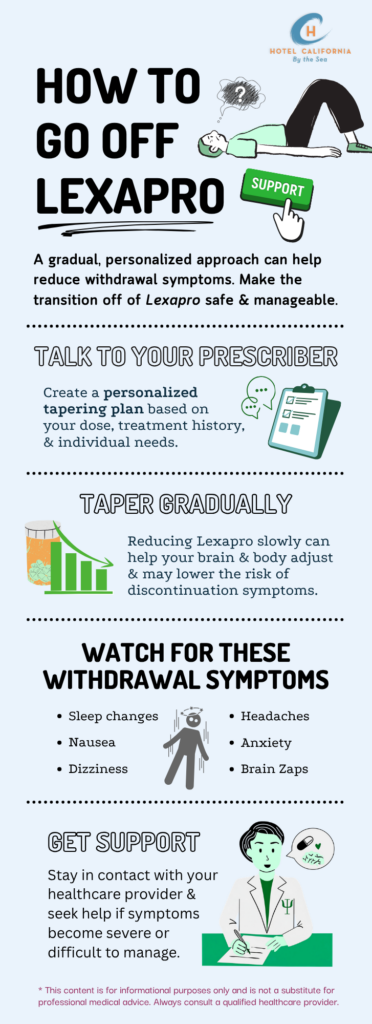
Antidepressant discontinuation symptoms can begin within 2 to 4 days after a dose reduction or after you have stopped taking a medication too quickly. Symptoms can last for up to 6 to 8 weeks, with the intensity and peak occurring about a day after medication is stopped. Different SSRIs affect the brain differently. On a scale of mild to severe, Lexapro withdrawals fall in the middle.
- Dizziness
- Anxiety and mood changes
- Insomnia
- Nausea and vomiting
- Brain zaps and headaches
- Difficulty with concentration
- Depression and suicidal thoughts
- Depersonalization
- Confusion
- Muscle tension
Check Your Insurance Coverage for FREE
Find out if your insurance covers addiction treatment in minutes. We accept most insurance!
How to go off Lexapro safely
The safest first step to coming off Lexapro safely is to agree on a tapering schedule with your clinician who prescribes your medication. The idea behind tapering is to cut down your dose gradually until you can stop the medication completely. A gradual taper reduces the medication dose in a controlled and systematic way. This gives the brain and body time to adjust to reduced levels of serotonin and makes it less likely that you will experience withdrawal symptoms.
Tapering is not one-size-fits-all. Tapering schedules should be individualized for each client. Two people on the same dose may need different tapering speeds. Someone who has taken Lexapro for a few months may have a different experience from someone who has taken it for years.
Factors to take into consideration:
- The starting dose. Your clinician needs to know your current daily dose and how consistently you take it.
- The reduction size. Some people tolerate larger reductions while others need smaller changes.
- Time between reductions. Your healthcare provider can suggest wait times between reductions to see how your body responds.
- How to measure doses. Tablets, scored tablets or liquid Lexapro can be discussed when smaller dose reductions are needed.
Tapering off Lexapro
Lexapro has a half-life of about 27 to 32 hours. Ultimately, it can take about 5 days for the medication to be fully removed from the body. Studies have found that people who have been on Lexapro for a longer period of time or at a higher dose need a much longer tapering schedule that can last anywhere from 6 to 12 months.
In some cases, a taper may need to get slower as the dosage also gets lower. Some people may feel fine during the first few reductions and then notice withdrawal symptoms towards the end. This can occur because smaller amounts can still feel meaningful to the body.
A strict rule most prescribers go by is treating symptoms as feedback. Mild, short-lived symptoms can be manageable with monitoring, sleep, hydration and support. But stronger symptoms that can interfere with work and relationships can feel more daunting and may be a sign to pause or slow down your taper.
An example of a Lexapro taper
Patients typically start at a standard or 20mg of Lexapro. In the first few weeks, the dose may be reduced to 15mg daily. In weeks 3 and 4, dose reductions can go down to 10mg daily. By weeks 5 and 6, the dose is reduced to 5mg daily. At week 7, clients may be able to completely stop drug use or switch to 5mg of Lexapro every other day based on guidance from the healthcare provider.
Reach out to Hotel California by the Sea
We specialize in treating addiction and other co-occurring disorders, such as PTSD. Our Admissions specialists are available to walk you through the best options for treating your addiction.
Treatment for Substance Use Disorder
If you are searching for how to go off Lexapro safely and effectively, the best route is to consult with your healthcare provider to create the best plan for you. It should be gradual, flexible and medically supervised. A safer taper takes into account your medical history, your current dose, your support system and how you respond to each step in your taper.
Do not abruptly go off your medication or drastically reduce your dose without the guidance of your prescribing clinician.
Hotel California by the Sea provides treatment for substance use disorder, including dependence and addiction to prescription medications. We offer treatment at all levels of care including detox, residential, PHP and IOP. We utilize evidence-based methods such as CBT, DBT and EMDR therapy. Hotel California by the Sea is dedicated to helping clients reach their goals in sobriety and overcome their addiction.
References:
https://www.talkspace.com/blog/lexapro-withdrawal
https://www.joinblossomhealth.com/blog/how-to-taper-off-lexapro
https://www.verywellmind.com/lexapro-withdrawal-symptoms-timeline-and-treatment-4707910
https://www.healthline.com/health/depression/weaning-off-lexapro