
Autism and Alcohol
Is there a correlation between autism and alcohol addiction? Researchers are still studying the link between the two conditions. There is still not much evidence proving a correlation, but some studies have found that autistic people might be at higher risk for developing a substance or alcohol use disorder. Other studies have found very little correlation between the two phenomena.

One study involving 330,000 youth in Taiwan found that those who were diagnosed with autism had a higher risk of developing a substance use disorder than non autistic youth. A study showing the opposite effects found that people diagnosed with autism actually have a lower risk for drinking and using drugs compared to the general population.
The Harvard Gazette reports that an estimated 20% of people with alcohol use disorder have autistic traits but remain undiagnosed. According to SPARK for Autism, a study found that up to 36% of people with autism had drug and alcohol related problems. But there is very limited data on the relationship between the two and it often produces conflicting results.
Autism Spectrum Disorder
In recent decades, there has been a growing number of people being diagnosed with autism. Autism is a spectrum disorder and developmental disability. There is a wide range of symptoms and severity that occur with this disorder. Some people may only have a few mild symptoms, allowing them to seemingly function as normal. While others may have a more severe case of the condition, which can hinder daily functioning in life.
It can affect a person’s behavior, language and how they interact with others. Those who are diagnosed with this condition often experience sensory differences compared to the general population. It is also known as sensory processing difficulties. For example, they may have increased or decreased sensitivity to sights, sounds, smells and textures. People with autism learn and interact differently with the world. An estimated 1 in 54 children in the US has been diagnosed with autism.
Main symptoms of Autism
- Intellectual disability
- Difficulty with social interactions
- Difficulty with communication
- Obsession with particular interests
- Great attention to detail
- Easily overstimulated
- Minimal eye contact
- Language regression
- Repetitive motor movements
Types of Autism
There are many different types of autism. Some of them include Asperger’s Syndrome (AS), Pervasive Developmental Disorder (PDD), Childhood Disintegrative Disorder (CDD) and Retts syndrome. People with autism are diagnosed on three different levels.
Autism Level 1: Mild. This form of autism is considered high-functioning. People with this diagnosis may have some difficulty with social interactions. They might struggle with switching between activities and may have a more challenging time staying organized and maintaining a schedule.
Autism Level 2: Moderate. This form of autism requires a higher level of support due to significant impairment in communication. They are generally inflexible to change and struggle with adjusting to focus. Repetitive behaviors can be noticeable to an outside observer.
Autism Level 3: Severe. This form of autism is the most severe. The person may have minimal communication skills. They can be completely non-verbal and can have a considerably difficult time coping with change. A disruption in routine can be highly distressing.
Autism and Alcohol
Alcohol addiction is a mental health disorder in which a person has reduced ability to control and manage their alcohol consumption despite continued adverse consequences. It is widely accepted that alcohol can become a coping strategy for social anxiety, stress management and a range of emotional distress. There is some research showing growing evidence that undiagnosed autistic adults are more prone to problematic alcohol use to help mask their autistic traits and symptoms.
A 2021 study found that autistic people had more than twice the risk of developing alcohol use disorder compared to non autistic people. Other research found that alcohol use is much less common in those with autism compared to the general public. Ultimately, there have been conflicting reports on the correlation between the two and not enough research or evidence has been found to prove a relationship one way or another.
Check Your Insurance Coverage for FREE
Find out if your insurance covers addiction treatment in minutes. We accept most insurance!
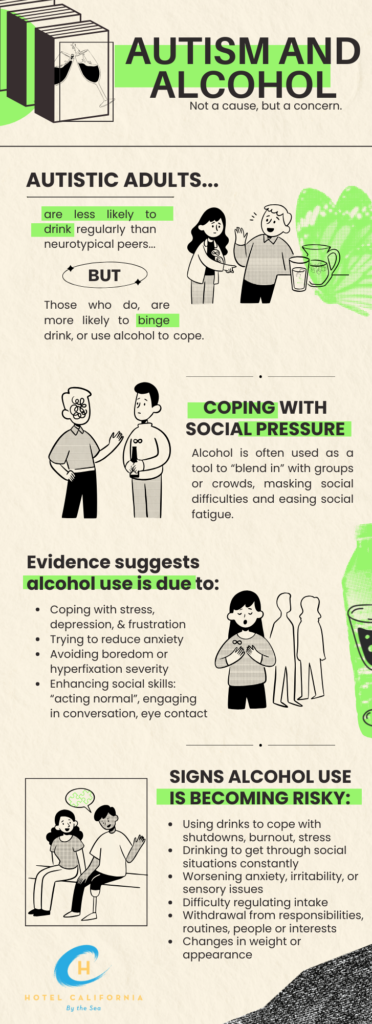
For the research findings that claim a correlation between autism and alcohol, evidence suggests alcohol use is due to the following:
- Cope with or reduce social anxiety, depression and stress
- Enhance social skills and mimic social norms such as making eye contact, engaging in small talk and “acting normal” in social settings
- Mask social difficulties by drinking to fit in
- Cope with challenging problems or to forget them because alcohol can provide temporary relief to reduce anxiety and sensory overload in social situations
- Overcome frustration
- Use alcohol as a masking agent to hide or lessen the severity of autistic symptoms such as hyper fixation and obsessive tendencies
- Clear their mind
- Cope with boredom
In studies that found very little correlation between autism and alcohol addiction, research found that people with autistic traits were over two times more likely to abstain from alcohol.
Autism and Addiction
There are some theories as to why some people with an autistic diagnosis are at higher risk for addiction. Brain wiring. Those with autism can be chemically predisposed to repetitive behaviors due to the way their brain works. Symptoms such as hyper fixation and obsessive tendencies fall in line with the risk of developing an addiction.
Signs of Addiction in a Person with Autism
- Changes in behavior
- Irritability
- Withdrawing from family and friends
- Changes in appearance
- Changes in weight
- Unexplained injuries
- Skipping important duties
- Borrowing money or having financial issues
- Changes in social groups
Reach out to Hotel California by the Sea
We specialize in treating addiction and other co-occurring disorders, such as PTSD. Our Admissions specialists are available to walk you through the best options for treating your addiction.
Treatment for Alcohol Use Disorder
Some research shows autistic adults are three times more likely to self-medicate with drugs and alcohol to suppress symptoms of anxiety and depression. While other research shows otherwise, it can be difficult to diagnose having both conditions. Behavioral health treatment programs like Hotel California by the Sea are able to provide treatment for those suffering from alcohol use disorder and any co-occurring disorders they may have.
We offer treatment at all levels of care including detox, residential, PHP and IOP. We utilize evidence-based treatment methods such as CBT, DBT and EMDR. Hotel California by the Sea is dedicated to helping clients reach their goals in sobriety and overcome their addiction.
References:
https://sparkforautism.org/discover_article/drugs-alcohol-autism
https://www.medicalnewstoday.com/articles/autism-and-alcohol-use
https://www.addictionhelp.com/addiction/autism