
Adderall vs Ritalin: ADHD Medications
Adderall and Ritalin are two of the most common ADHD medications. They are part of the same drug class but are not interchangeable. Understanding the differences is important for effective ADHD management. What are the differences and similarities between Adderall vs Ritalin?
Both are central nervous system stimulants that aim to improve focus and reduce impulsivity. But they contain different ingredients and work in slightly different ways. Like any other stimulant substance, these medications also carry a risk of dependence and addiction if they are misused. But in most cases, the drug is safe and effective when used as prescribed by a medical provider.
Choosing between Adderall vs Ritalin can be challenging. It depends on personal response and side effect profiles. Each medication has its own set of benefits and drawbacks.
Overview of ADHD and Stimulant Medications
Attention-deficit hyperactivity disorder (ADHD) is a common lifelong neurological condition that affects both children and adults. It causes executive dysfunction, which means it can keep you from being able to control your thoughts, emotions and behaviors, affecting attention, focus and energy. The CDC estimates that about 6 million children in the US have been diagnosed with ADHD.
Medication is the first line of defense in treating ADHD. It is effective in helping to enhance focus and self-control. Stimulant medications work by increasing the availability of dopamine and norepinephrine in the brain. This helps to improve focus and decrease hyperactive behaviors. Because of this, stimulant medications are often the first line of defense for treatment due to their effectiveness.
Common stimulant prescription medications include Adderall, Ritalin, Concerta, and Vyvanse. The two most popular are Adderall and Ritalin. Adderall contains a mix of amphetamine salts, while Ritalin contains methylphenidate. Each of these medications has its own unique properties and discussing options with your healthcare provider can determine the best fit for you.
What is Adderall?
Adderall is a well-known medication that falls under the class of drugs called amphetamines. It is a combination of two main stimulants: amphetamine and dextroamphetamine. These help increase the levels of dopamine and norepinephrine in the brain by preventing neurochemical reuptake as well as increasing dopamine levels so that there are more available in the brain.
The medication is available in both immediate-release and extended-release formulations. When used as prescribed, the medication can improve attention span, reduce impulsive behavior and enhance focus and concentration.
But, like all medications, Adderall carries side effects. Common symptoms can include insomnia, decreased appetite and increased heart rate. In more serious cases, it can lead to dependence and addiction. If a person does develop an addiction, it is because they have psychologically become dependent on the drug rather than physically.
What is Ritalin?
Ritalin is another popular ADHD medication that contains the active ingredient methylphenidate. It works by enhancing dopamine and norepinephrine in the brain. It is also available in both immediate-release and extended-release formulations. The various forms allow for flexibility in management for ADHD symptoms.
Ritalin is often prescribed to children due to its milder side effects. Some of the advantages of using Ritalin include a quicker onset of action and effects, versatility in dosing and a well-established history of pediatric use.
Check Your Insurance Coverage for FREE
Find out if your insurance covers addiction treatment in minutes. We accept most insurance!
Adderall vs Ritalin
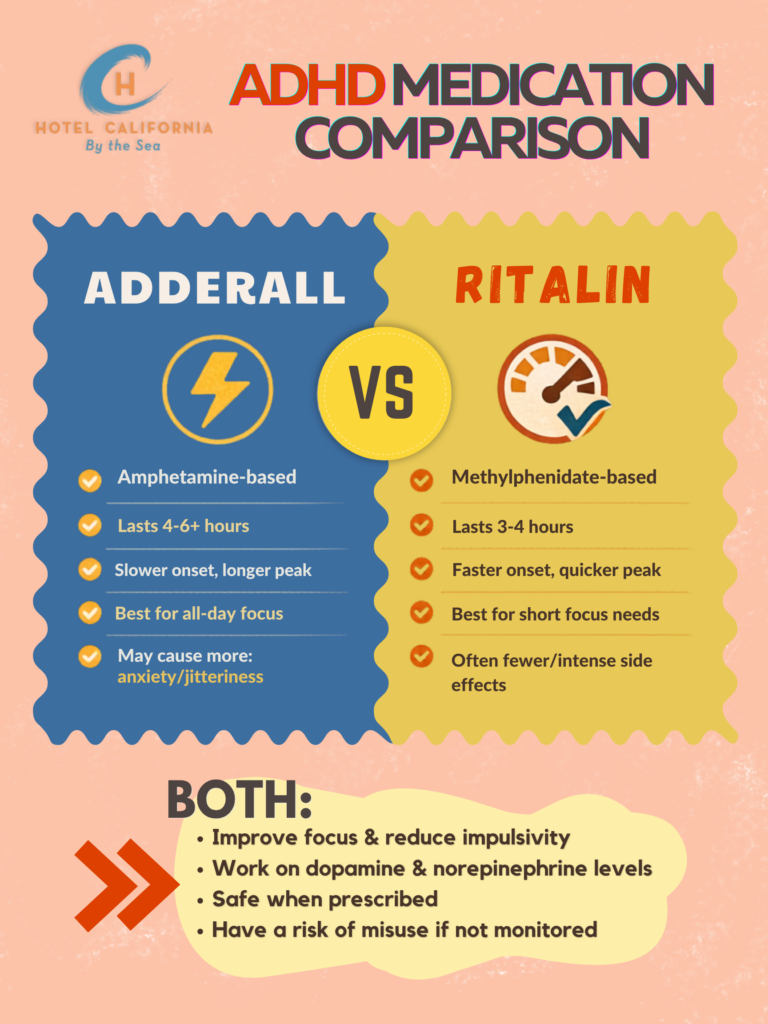
Adderall and Ritalin are both effective in treating symptoms of ADHD. They also have several distinguishing characteristics due to differing ingredients and slightly different mechanisms of action.
Both come in various forms such as tablets, chewable and oral solutions. Both medications are approved differently for different age groups. Both medications also take effect fairly quickly within 30 to 45 minutes.
However, users may feel the effects of Ritalin more quickly because its peak in the bloodstream occurs within a few hours. Ritalin may be preferred for those who need immediate symptom relief. Adderall peaks later at around 3 hours after ingestion.
Adderall typically lasts longer in the body due to its 10 to 14 hour half-life. Ritalin’s half-life is around 2-3 hours. The effects of Ritalin can be felt between 3 to 4 hours, whereas the effects of Adderall can be felt anywhere between 4 to 6 hours.
Ritalin is best suited for those who need short focus periods and are sensitive to stimulation. Because of the shorter duration of effectiveness, users who take Ritalin may need to take multiple doses. This can also provide more flexibility with dosing. You may not need full-day coverage and prefer a milder or controlled effect.
Adderall is best for long days and stronger symptom control. You won’t need to take Adderall as often due to its long-lasting nature. This is also convenient for fewer dosing decisions. Adderall is also best for those who struggle with motivation over distraction.
Both medications generally have the same side effects, such as decreased appetite, weight loss, insomnia, increased heart rate, headache, dizziness and upset stomach. However, Adderall can sometimes cause more mood changes, such as increased anxiety and jitteriness.
How do Adderall and Ritalin work?
The general mechanisms of both drugs work similarly: they increase the amount of dopamine and norepinephrine in your brain. Both medications are designed to target neurological pathways influenced by brain chemicals. This helps to improve the ability to focus, maintain attention and improve impulse control.
The brain relays messages through your body via connections called synapses. Messages travel from one synapse to the next to create fully formed thoughts and actions. In the brain of a person with ADHD, the messages can get lost while attempting to travel from one synapse to another. During all this, synapses reuptake return the messages to the original sender instead of passing along the message.
Both medications work to stop the reuptake from happening and push the original message over to the next synapse receiver.
Two major brain chemicals are being passed around in the brain: dopamine and norepinephrine. Dopamine is a neurochemical that is involved in motivation and increases the sense of reward association with your actions. Norepinephrine is a chemical that helps you focus and stay organized by helping your brain prioritize bits of information.
Ritalin and Adderall both affect these two neurochemicals. Ritalin blocks the reuptake of dopamine and norepinephrine by slowing down how quickly these chemicals are reabsorbed. This means more of them are available to use in the brain.
Adderall also works to block the reuptake of neurochemicals. Adderall also works to release more dopamine and norepinephrine. This dual effect can have a stronger mechanism and make the drug feel stronger and produce a more noticeable change when effects start to kick in.
Reach out to Hotel California by the Sea
We specialize in treating addiction and other co-occurring disorders, such as PTSD. Our Admissions specialists are available to walk you through the best options for treating your addiction.
Treatment for Substance Use Disorder
Both Adderall and Ritalin are medication stimulants. Despite being a medication prescribed by a healthcare provider, they still carry a risk for misuse. They are classified as a Schedule II Controlled Substance. Regular monitoring when using this medication is critical for the safety of the patient.
Professional behavioral health programs like Hotel California by The Sea provide treatment for those who have misused prescription stimulants and developed an addiction. We offer treatment at all levels of care including detox, residential, PHP and IOP. We utilize evidence-based methods such as CBT, DBT and EMDR therapy. Hotel California by The Sea is dedicated to helping our clients reach their goals of sobriety and overcome their addiction.
References:
https://health.clevelandclinic.org/ritalin-vs-adderall
https://www.healthline.com/health/adhd/adderall-vs-ritalin
https://www.adhdadvisor.org/learn/ritalin-vs-adderall
https://www.healthcentral.com/condition/adhd/ritalin-vs-adderall