
Top Smoking Cessation Drugs
Nicotine physically alters the neural receptors in your brain. Once you start smoking nicotine, it can be very difficult to quit if you have become dependent and addicted to the substance. Smoking cigarettes as a part of a daily routine can easily turn into a severe battle of physical addiction vs habit. Fortunately, there are many options for smoking cessation drugs and medications available to help.
According to major public health studies, utilizing proper medical support when it comes to smoking cessation can double your chances of long-term success. Modern quit-smoking aids are not shortcuts. They act as a vital weapon to block cravings and treat physiological needs.
FDA-approved smoking cessation drugs fall into a few main categories: nicotine replacement therapies and non-nicotine prescription medications. Some of the replacement therapies that contain nicotine as the active ingredient include patches, gum and lozenges. These items can be found over the counter at your local pharmacy or drug store. Non-nicotine medications include bupropion and varenicline. These medications require a prescription.
Signs you may be Dependent or Addicted to Nicotine
- You smoke more than one pack of cigarettes per day
- You smoke within 5 minutes of walking up
- You smoke nicotine even while you are sick and trying to heal
- You wake up in the middle of the night because you feel the need or urge to smoke nicotine
- You smoke nicotine to ease the symptoms of nicotine withdrawal
How effective are the Treatment options of Nicotine Cessation?
According to studies from the Smoking Cessation Leadership Center at the University of California, San Francisco, there are many treatment options for smoking cessation and each has a different level of success.
Those who decided to quit smoking on their own using the self-help method resulted in about 9 to 12% of nicotine smokers actually quitting.
Those who utilized professional counseling services resulted in a quit rate of around 13 to 17%.
Those who utilized FDA-approved medication Bupropion resulted in a quit rate of 24%.
Those who participated in nicotine replacement therapy (NRT) resulted in a quit rate of around 19 to 26%.
Those who utilized FDA-approved medication Varenicline resulted in a quit rate between 26 to 36%.
And those who chose professional counseling combined with prescription medications resulted in a quit rate between 26 to 32%.
Smoking Cessation Drugs
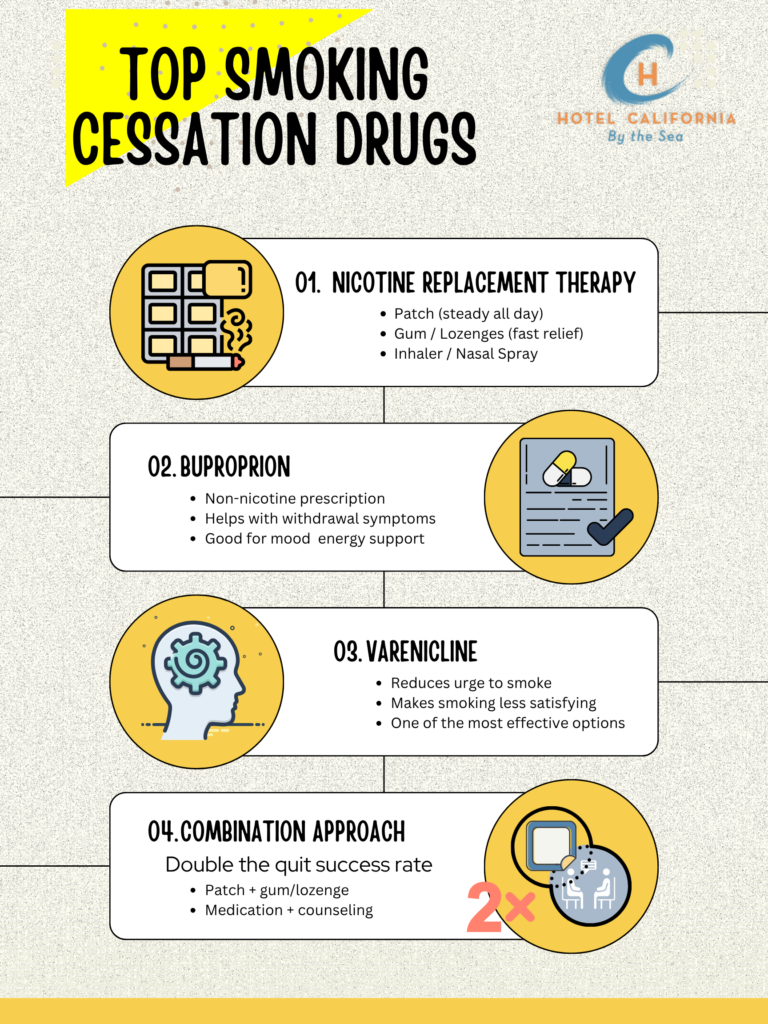
Smoking cessation drugs help users lessen the cravings of nicotine, decrease withdrawal symptoms and help keep the user from starting the use of tobacco again. There are two main medications that are FDA-approved to help with smoking cessation: Bupropion and Varenicline.
Bupriopion
Bupropion is the first non-nicotine medication shown to be effective for smoking cessation. It was first approved in 1997 and is often used in combination with nicotine replacement therapy. It works by helping to decrease cravings and treat nicotine withdrawal symptoms.
It is originally an antidepressant prescription medication that acts on chemicals in the brain that are associated with nicotine cravings. For those who are quitting nicotine and worried about mood swings, bupropion is often the medication of choice for providers and clinicians. The medication focuses on keeping emotions steady while the body detoxes.
Nicotine artificially spikes dopamine levels in the brain. Quitting nicotine will cause a stressful drop in levels. Bupropion makes sure the dopamine levels remain balanced, which is crucial for managing nicotine withdrawal symptoms.
Once you take this medication, it may take a week or so for the medication to fully take effect. It is advised to take it about a week before your intended quit date. Common side effects of the medication include dry mouth, stuffy nose, difficulty sleeping, tiredness, difficulty focusing, constipation, nausea, high blood pressure, risk of seizure, depression, anxiety and confusion.
Varenicline
Varenicline is a non-nicotine-based medication FDA-approved in 2006 that mimics the effects nicotine has on certain parts of your brain. It helps to reduce the urge to smoke and reduces the enjoyment you experience when smoking nicotine cigarettes. The medication attaches to the same parts of the brain that nicotine attaches to, but without stimulating them as strongly as nicotine. This also means the nicotine from cigarettes has fewer places to attach to because it’s being blocked by the varenicline.
When taking this medication, doctors use a specific timeline in order to see results. Over the first week or so, you will continue your normal smoking routine while the medication gradually circulates and locks into your brain. When the receptors are fully occupied with varenicline, the inhaled nicotine has nowhere to go. The puff of the cigarette won’t provide the usual stress relief feelings and satisfaction you normally expect.
Typical side effects from the medication include nausea, headache, difficulty sleeping, constipation, changes in taste, skin rash, heart or blood pressure, mood or behavioral changes, depression, hallucinations, delusions, aggression, anxiety and sudden panic ideation.
Other Medications that are used off-label to treat smoking cessation
- Nortriptyline – An antidepressant that helps to reduce tobacco withdrawal symptoms
- Clonidine – It is not commonly used, but this high blood pressure medication can be an option if other medications don’t work
Check Your Insurance Coverage for FREE
Find out if your insurance covers addiction treatment in minutes. We accept most insurance!
Nicotine Replacement Therapy (NRP)
Quitting nicotine cold turkey can feel like jumping off a roof. It is difficult because nicotine is a highly addictive substance. Nicotine replacement therapy offers a much safer alternative: tapering. Tapering off a drug is the gradual step-down to reducing your physical dependence on the drug over time. NRT delivers clean nicotine without the dangerous toxins found in cigarette smoke. It eases the transition of withdrawal.
There are five common forms of NRT:
Patch: Nicotine patches are long-acting and provide a steady release over 24 hours
Gum: Nicotine gum is fast-acting and can provide relief within 5 to 10 minutes
Lozenges: Nicotine lozenges are also fast-acting and provide immediate relief within 10 to 15 minutes
Prescription inhaler: These provide fast-acting relief within minutes
Prescription nasal spray: These are also fast-acting forms that hit the bloodstream almost immediately
Using nicotine patches effectively usually involves applying one daily to build up a continuous shield to help prevent you from walking up desperate for your nicotine fix. Then, if you happen to have a stressful afternoon or are triggered by something, chewing the gum can provide immediate relief.
Providing a clean nicotine experience can be very effective for anyone who is trying to quit. For others, they need tools that work to alter how the brain reacts to nicotine. If tapering off tobacco doesn’t fit your needs, the route of prescription medications such as non-nicotine-based bupropion and varenicline could be more effective.
Combination Therapy
Sometimes a single tool is just not enough to break the cycle. Your doctor might suggest a combination of therapies for quitting smoking. This means using multiple FDA-approved medications for smoking cessation. This might also mean using combinations of different NRT methods to boost the success of nicotine cessation.
Doctors often recommend these dual-action pairings:
- Patch and gum
- Patch and lozenges
- Bupropion and short-acting NRT
Reach out to Hotel California by the Sea
We specialize in treating addiction and other co-occurring disorders, such as PTSD. Our Admissions specialists are available to walk you through the best options for treating your addiction.
Treatment for Substance Use Disorder
Smoking cigarettes is as common as drinking alcohol. Contrary to popular belief, nicotine and tobacco are highly addictive substances. It is possible to become addicted to nicotine. Our professional behavioral health program Hotel California by the Sea provides treatment for those with substance use disorder such as nicotine and tobacco.
We offer treatment at all levels of care including detox, residential, PHP and IOP. We utilize evidence-based methods such as CBT, DBT and family therapy. Hotel California by The Sea is dedicated to helping our clients reach their goals in sobriety and overcome their addiction.
References:
https://medlineplus.gov/ency/article/007439.htm
https://smokingcessationleadership.ucsf.edu/treatment-options