
Ricky’s Law: Navigating Involuntary Rehab
Watching a loved one spiral into addiction can be one of the most difficult and painful experiences families can endure. When addiction, a brain disease, takes control, the person’s ability to make rational and life-saving decisions often disappears. For decades, families have struggled to find ways to get their loved ones the help and treatment they need for substance abuse. In the state of Washington, Ricky’s Law allows for certain people in addiction crisis to be placed into involuntary treatment when they have become a danger to themselves and others.

When exploring the realities of Ricky’s Law and involuntary rehab, this legislation has been seen as a critical lifeline for many who are incapable of seeking help on their own. Those who are suffering from a substance use disorder often have serious mental health crises as well as being at risk for harm. Ricky’s law was designed to protect those who are too sick, confused or too unstable to make logical decisions on their own.
What is Ricky’s Law?
Ricky’s Law was passed in 2016 and went into full effect in 2018. It enables loved ones, trained professionals and public safety officials to place a person experiencing substance abuse into treatment. The law was created to save lives and give individuals a chance to start recovery in a safe place.
The law was named after Ricky Garcia, a young man who suffered from severe drug addiction and mental health. Despite facing life-threatening medical emergencies due to substance addiction, his friends and family were unable to get him into treatment under the law at the time. Ricky’s best friend Laruen Davis, was a champion of the legislation to close this gap in the healthcare system. Even Ricky himself wished there was a similar policy in place to help him.
Ricky’s Law is part of the Involuntary Treatment Act (ITA) in the state of Washington for substance use disorders. The ITA now covers mental health crisis, substance use crisis, assessments, court hearings, treatment timelines and safety rules. Ricky’s Law expanded the ITA so that people suffering from severe substance addiction could receive the same protection as those who were suffering from a mental health crisis.
Under this new policy, individuals suffering from life-threatening substance use disorder can be detained and treated under the same legal criteria as those experiencing severe mental health crisis. It recognizes addiction as a brain disease that can take away a person’s capacity to choose survival.
Who qualifies for involuntary treatment under Ricky’s Law?
Taking away civil liberties even for medical treatment is a profound action. This is why Involuntary rehab is heavily regulated. In order to detain someone, there are medical and legal guidelines and certain criteria that need to be met. A person cannot be committed simply because they are using drugs or alcohol.
The person must be a danger to themselves. This means they have attempted self-harm, have been talking about suicide, have been using substances to the point where it is life-threatening, they are no longer eating or drinking and they are refusing medical attention.
The person must be a danger to others. This is when the person is making serious threats to others, acting aggressively towards others, and behaving recklessly around or towards others.
When a person is unable to care for themselves, they are considered a person with a grave disability. They may be wandering around outside confused, they may not be sleeping for days, they may not be able to function safely and they may have severe disorganized thinking. They have failed to provide for their own essential human needs or safety. This is a person who would qualify for help under Ricky’s Law.
Typically, a person who is suffering from severe substance use disorder may also have a dual diagnosis. They may also be experiencing severe mental health crisis such as psychosis, hallucinations, severe withdrawal symptoms or engaging in dangerous behaviors. These situations fall under the criteria of a person who may benefit from Ricky’s Law.
How does it work? What is the Commitment process in Washington?
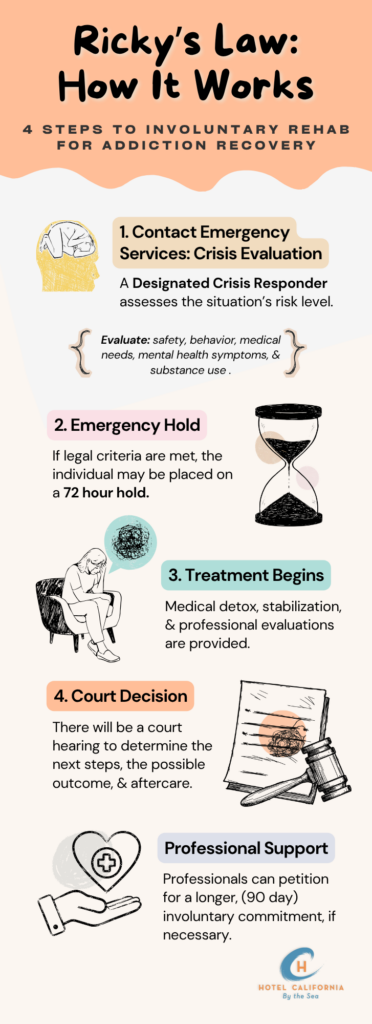
- Contact a designated crisis responder. You can do this through reporting to a crisis hotline or through emergency services. A designated crisis responder is a specialized mental health professional legally authorized to detain individuals under Ricky’s Law.
- The evaluation process. The crisis responder will do an evaluation and assess safety, behavior, medical needs, mental health symptoms, substance use patterns and determine risks of harm.
- Emergency detention. If a person qualifies for involuntary detention, they can be placed into treatment for up to 72 hours. Law enforcement or medical transport will escort the person to the appropriate treatment facility.
- The 72-hour hold. The individual will be detained for a 72-hour evaluation and treatment hold, during which they will receive medical care, including detox, where clinical professionals will assess their condition.
- There will then be a court hearing to determine the next steps and possible outcome. Professionals can petition the court for longer involuntary commitment, which can also be extended to 90 days if necessary. Other options include follow-up care, extended treatment, outpatient treatment or longer inpatient programming.
Check Your Insurance Coverage for FREE
Find out if your insurance covers addiction treatment in minutes. We accept most insurance!
The great debate over Involuntary Rehab Treatment
The United States has been experimenting with these involuntary and forced commitment laws for many decades. Especially when it comes to treatment for substance addiction. There has been ongoing debate over the efficacy and practicality of the process. But some states like New York, California and Washington are seeing renewed urgency as mental health and substance addiction are becoming highly political issues.
Ricky’s law raised the question of what constitutes helpful and compassionate addiction policy. The law has designated tens of millions of dollars to create holding places for people who have been detained under the policy. There are now close to 50 Ricky’s Law beds in several treatment facilities across the state of Washington. According to the Washington Health Authority, the state has admitted an estimated 700 people annually to substance use facilities under Ricky’s Law.
A Practical Guide for Families Seeking Help
If you are dealing with a loved one in crisis from substance addiction, it can feel very hopeless and isolating. There are a few actionable steps you can take to help you through it.
- Do not wait for tragedy to strike. Don’t wait for your loved one to hit rock bottom before taking action. If the person is displaying signs of grave disability, contact a local crisis hotline and ask about the evaluation process.
- Gather your contacts. When the designated crisis responder conducts their investigation and assessment, they will want to speak to witnesses. Have your contact information ready. People such as employers, landlords or friends who have witness that dangerous behavior.
- Manage your expectations. Involuntary rehab is an emergency intervention. It is not a permanent cure. The goal is to keep the person alive today so they can get into treatment and sobriety tomorrow.
- Don’t forget to seek support for yourself. Having a loved one with a severe addiction takes a major psychological and physical toll. Addiction impacts the entire family and community. Support groups like Al-Anon and Nar-Anon help families and loved ones of addicts find support and guidance from those who have experienced this journey.
Reach out to Hotel California by the Sea
We specialize in treating addiction and other co-occurring disorders, such as PTSD. Our Admissions specialists are available to walk you through the best options for treating your addiction.
Treatment for Substance Use Disorder
The reality is, involuntary rehab service is for emergency interventions when there is a desperate, yet necessary need for help. Policies like Ricky’s Law have helped many people in dire situations. Professional behavioral health programs like Hotel California by the Sea provide treatment for those with a drug and alcohol addiction. We offer treatment at all levels of care, including detox, residential, PHP and IOP. We utilize evidence-based methods that include CBT, DBT and family therapy. Hotel California by the Sea is dedicated to helping clients reach their goals in sobriety and overcome their addiction.
References:
https://www.theguardian.com/society/article/2024/may/13/rehab-forced-addiction-treatment
https://welevelupwa.com/rickys-law/
https://amfmtreatment.com/blog/how-washington-is-transforming-involuntary-treatment/