
Impact of the DARE Program
The DARE program is one of the most recognizable school-based drug intervention efforts in the nation. DARE: Drug Abuse Resistance Education. DARE is a comprehensive drug and violence prevention education program created for students in grades K through 12. Most adults have memories of uniformed police officers leading classroom discussions, going over informative worksheets, and distributing t-shirts about substance abuse education.

DARE is a nationally coordinated program between state and local agencies and communities. It was originally designed to equip students with the appropriate skills to resist substance abuse, violence and gangs. The program has gone through a few evolutions throughout the years, leading to added initiatives that include an emphasis on decision-making and communication rather than solely focusing on drug prevention.
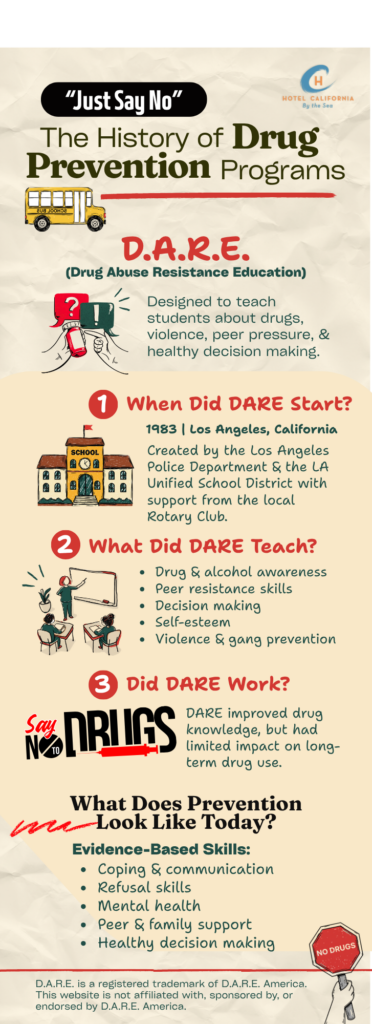
History: When did the DARE program start?
DARE was created as a global initiative in 1983 as a collaboration between the Los Angeles Police Department, Los Angeles Unified School District and a local Rotary club. The mission was to help educate students about the risks and consequences associated with drug use, gangs and violence.
The program was created in response to rising concerns about drug addiction and youth violence. It helped set a template for many later school-based prevention efforts and made the DARE program an international brand.
DARE stands for Drug Abuse Resistance Education. DARE was traditionally delivered in programs at school starting from grade 5 and beyond. The program was made famous for its emphasis on refusal skills and the idea of “just say no.”
The program was a collaboration effort between schools and local law enforcement, making one of its defining features having a police officer in classroom education. The DARE program aims to:
- Teach students about the risks of alcohol, tobacco and other drugs
- Build refusal and peer resistance skills
- Encourage healthy decision-making and self-esteem
- Strengthen community relationships
Today, modern DARE programs aim to be more culturally competent. It focuses on science-based interventions and peer interactions. It has expanded its topics to include cyberbullying and internet safety. The program addresses coping skills, support networks, peer pressure, peer support and the mental health aspects of substance abuse.
Stages of Drug Use in Teens and Young Adults
An estimated 90% of teens will end up trying alcohol or marijuana. The majority are motivated simply by curiosity. They may have seen adults use it or may have seen it glorified through pop culture media. An estimated ¾ of teens who enter the experimentation phase will go on to stage two, which consists of social use.
They will begin using with other teens at parties, gatherings and in a social setting. Teens will often mimic the behaviors they see displayed around them. The third phase of teen drug use is when they begin to actively seek out places where drugs can be found. This is typically when dependence and addiction begin.
Habitual use is when teens move into a primary desire to use drugs despite the negative consequences or harmful effects that can occur. This addiction phase can be both physical and psychological.
Is the DARE Program still in Schools?
In many communities, the DARE program is still a regular part of the elementary school curriculum in some shape or form. At the same time, there are many districts that have either reduced or replaced it with other programs because they prefer to prioritize evidence-based prevention programs with stronger clinical support. DARE still exists in some schools, but it is not as universally adopted as it once was.
Does the DARE Program help reduce drug use?
At its peak, the DARE curriculum was a part of 74% of American schools. The question does DARE reduces drug use has been studied for decades. The findings are mixed. Did the program change attitudes and knowledge? Did it reduce later substance use behaviors?
Older research suggested that knowledge and short-term attitudes towards drug use somewhat improved. And long-term behavior change was not statistically meaningful in many studies. Studies in the early 1990s and 2000s found that the program had no significant impact on drug use. In a few of these studies, findings actually saw an uptick in drug use among those who participated in the school program.
The emphasized slogan and message of “just say no” wasn’t very effective in protecting students from drug abuse.
Because of the mixed results, the DARE program critiques often centered on the following:
- Overreliance on information and catchy slogans rather than skill practice
- Limited exposure (too few sessions to make meaningful changes in behavior)
- Lack of strong follow-up or reinforcement across middle school and high school
- Insufficient integration with the broader youth developmental education
Check Your Insurance Coverage for FREE
Find out if your insurance covers addiction treatment in minutes. We accept most insurance!
What should effective Evidence-Based Prevention Programs look like?
There are a few things to look for when finding the right program for your community. Strong evidence-based prevention programs have a few themes in common.
- Clear target age group (elementary, middle or high school)
- Skill-based, actionable practices, not just delivery of information
- Teacher training and coaching support
- Culturally appropriate for the student population
- Measurable outcomes that align with district goals
- Tools like lesson guides, observation rubrics and simple assessments
Actionable steps for Schools and Parents
Regardless of whether you use the DARE program, the outcomes of the message are treated as a system with the help of everyone. This includes efforts from the school and efforts at home.
For Schools and Educators:
- Use role-playing techniques that involve examples students may actually face in real-life situations like vaping at a friend’s house or facing peer pressure from an older sibling who smokes and drinks.
- Educate teens on the risk of drug use and the physical, psychological and social harms
- Practice exit lines and help-seeking scripts to follow when a situation arises
- Normalize the discomfort and curiosity while being able to set clear boundaries
- Make the curriculum interactive where students are able to practice their skills
- Coordinate messaging so students see and hear the same “rules” across all adults and authority members
For Parents and Families:
- Setting clear family expectations, guidelines and boundaries about substance abuse
- Practicing refusal language together
- Asking open-ended questions and sharing your thoughts and feelings about drug use
- Being a positive role model of values because adult decisions are new to teens and they need values and beliefs that they can base their actions on
- Filter out the negative and filter in the positive influences
- Become familiar with your teens’ social media use, learn to use parental controls and watch what your teens do and what they are looking at
- Provide healthy opportunities for challenge
Reach out to Hotel California by the Sea
We specialize in treating addiction and other co-occurring disorders, such as PTSD. Our Admissions specialists are available to walk you through the best options for treating your addiction.
Treatment for Substance Use Disorder
The mission of the DARE program is to provide students with information and skills to make healthy decisions for their future. The program that originally focused on drug use, gangs, and violence has now expanded into internet safety, prevention of cyberbullying and improved communication and decision-making skills. The DARE program is just one part of the substance prevention and treatment journey. Professional behavioral programs like Hotel California by the Sea offer a different benefit when teens have already found themselves in the throes of addiction.
We provide treatment at all levels of care, including detox, residential, PHP and IOP. We utilize evidence-based methods such as CBT, DBT and EMDR therapy. Hotel California by the Sea is dedicated to helping clients reach their goals in sobriety and over their addiction.
References:
https://www.ojp.gov/pdffiles/darefs.pdf
https://activeparenting.com/drug-abuse-resistance-education-d-a-r-e/
https://priceonomics.com/dare-the-anti-drug-program-that-never-actually/
https://www.npr.org/2023/11/09/1211217460/fentanyl-drug-education-dare
https://www.ebsco.com/research-starters/education/dare-drug-abuse-resistance-education