
Brownout vs Blackout Drunk
We’ve all heard of being blackout drunk, an occasion where a person consumes enough alcohol to cause memory loss. But have you ever heard of brownout drinking? It is a term that refers to a state of intoxication from alcohol consumption that causes lapses in memory from long-term memory storage.

Brownouts occur when a person drinks to the point where they can suffer from partial memory loss. They may be able to recover pieces of the events that occurred during their drinking timeline with the help of certain cues or triggers.
Alcohol misuse and abuse can impact the brain’s hippocampus. It limits the brain’s ability to encode and store new memories. When a person becomes brownout drunk, they will have difficulty recalling memories and may only be able to recall bits and pieces.
During brownout drinking, a person may experience waves of hours of memories that they are unable to remember. Brownout drinking may seem less severe compared to blackout drinking. However, it still has a significant impact on alcohol impairment and brain damage.
What is Alcohol’s impact on the brain and overall health?
Alcohol abuse can lead to a whole array of health issues. It can cause liver damage, heart problems, immune system suppression, gastrointestinal issues and neurological issues. It can also significantly impact brain functions, which directly impact behavior and emotions. These issues include development or worsening of anxiety and depression, increased risk of addiction, impaired judgment, social isolation and emotional instability.
One part of the brain that is greatly impacted by alcohol abuse is the hippocampus. When a person is sober, memories are formed after sensory input is processed in the short-term memory storage, called transfer encoding. When there is excessive alcohol consumption, it can trigger a chemical reaction in the brain that disrupts the process and prevents the brain from making new memories. Basically, it prevents the transfer of memory from short-term to long-term storage.
It can also shrink the hippocampus. When the hippocampus shrinks, it can lead to serious cognitive decline in both long-term and short-term memory. It can also cause difficulty solving complex problems, spatial confusion and other issues.
Signs that a person may be abusing Alcohol
- Depression and anxiety
- Poor impulse control
- Cravings for alcohol
- Poor sleep
- Relationship issues with friends, families and partners
- Difficulty at work
- Engaging in risky behaviors
- Experiencing withdrawal symptoms when you try to stop alcohol
- Making plans that only involve drinking and revolve around alcohol
What is Brownout Drinking?
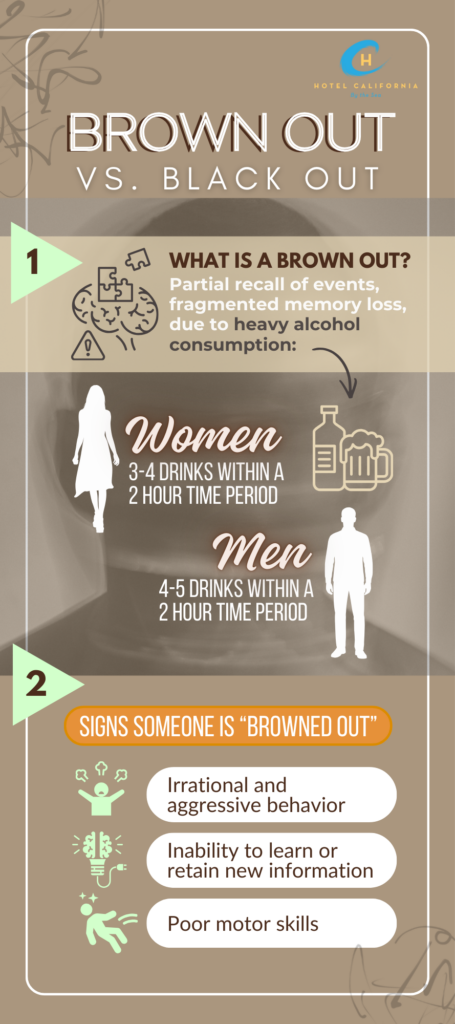
Brownout drunk is when a person experiences fragmented memory loss due to heavy alcohol consumption. It is often characterized by partial recall of events that can later be put together through external cues, such as hearing through another person’s account of what happened or seeing photos and videos of the event.
When a person is in a brownout state, they can appear coherent and functional. They are usually able to carry on normal conversations and perform normal activities. But they may not remember every part of their interactions and events that occurred during the drinking period.
Brownout drinking is when women have around 3 to 4 drinks within a 2-hour time period. And for men, it is about 4 to 5 drinks. During a brownout, the average blood alcohol concentration in a person is between .012 to .014%. At this stage, memory can become spotty and the person can experience several hours of missing memory.
Common short-term side effects of brownout drinking include memory gaps, dehydration, headaches, nausea, vomiting, anxiety, fever, chills and difficulty with sleep.
Signs that someone is Brownout drunk
- Irrational or aggressive behavior
- Inability to remember recent events
- Poor motor skills
- Inability to learn and retain new information
Brownout vs Blackout Drunk
Brownouts and blackouts are two different types of consequences of alcohol overconsumption. They are both associated with varying intensities of memory loss.
Blackout drinking is when there is a total loss of memory throughout the drinking event, with no ability to remember anything, even when prompted with cues or triggers. College-aged students and young people are most at risk of blacking out while drinking. Women are also at a higher risk of blacking out compared to men.
Blacking out occurs when a person’s blood alcohol concentration reaches .016%, which is twice the legal limit of blood alcohol concentration in an average person. At this level of intoxication, men and women will experience significant cognitive impairment, lack of impulse control and lack the ability to make sound decisions.
There are two main forms of alcohol blackouts. En bloc or a complete blackout is when there is total memory loss of events until the body is able to lower its blood alcohol concentration levels back to normal. During this period, the person is unable to recall anything during the period in which they were drinking.
Fragmentary blackout or partial memory loss occurs when a person loses partial recollection of events during the drinking period. This is also often referred to as brownout drinking. Blackout and brownout drinking are a result of how quickly a person consumes alcohol in a short period of time and not necessarily how much alcohol they consume.
Check Your Insurance Coverage for FREE
Find out if your insurance covers addiction treatment in minutes. We accept most insurance!
Blackout Drinking
- Total inability to remember events that happened while intoxicated.
- Period of alcohol-induced amnesia in which a person actively engages in behaviors like walking and talking but cannot remember doing so. Complete amnesia can span hours. In severe cases, memories are not formed and cannot be recovered. It is as if they didn’t even happen.
- Temporary complete loss of memory.
- Caused by a rapid increase in blood alcohol concentration levels from binge drinking or consuming alcohol on an empty stomach.
- Blackouts are more likely to occur in a person who is also taking other medications for sleep and anxiety.
- Blackout drinking can lead to alcohol poisoning and brain damage.
Brownout Drinking
- Partial lapses of memory loss of events that happened while intoxicated. A milder induced memory impairment.
- Spotty memories from the events with memories separated by missing periods of time in between.
- Can lead to confusion and distress.
- Can increase the likelihood of accidents and poor decision-making.
- Brownouts are more common in college-aged students and middle-aged adults.
- Brownout drinking causes neural pathways to get disrupted in the brain and damages brain signals that communicate to the hippocampus.
- Brownout drinking can be very harmful, but it does not cause permanent damage the way blackout drinking can.
How to cope with Brownout Drinking
- Find a cool and quiet place to sit down with a person you trust to help you in case of an emergency.
- Drink enough water and eat food to help you regulate the electrolytes in your body.
- Stop bingeing and consuming alcohol.
Reach out to Hotel California by the Sea
We specialize in treating addiction and other co-occurring disorders, such as PTSD. Our Admissions specialists are available to walk you through the best options for treating your addiction.
Treatment for Alcohol Use Disorder
Brownout drinking is a form of blackout drinking in which a person only loses partial memory while intoxicated. Brownout drinking occurs when blood alcohol concentration levels are elevated within a short period of time cause spotty memory here and there that can be recovered with the help of external cues. However, this type of drinking can be dangerous and can lead to the development of alcohol tolerance, dependence and addiction.
Professional behavioral health programs like Hotel California by the Sea provide treatment for alcohol use disorder. We offer treatment at all levels of care including detox, residential, PHP and IOP. We utilize evidence-based methods like CBT, DBT and MAT. Hotel California by the Sea is dedicated to helping clients reach their goals in sobriety and overcome their addiction.
References:
https://www.choosingtherapy.com/brownout-drinking
https://www.rightstep.com/rehab-blog/whats-the-difference-between-a-brown-out-and-a-black-out/
https://trueselfrecovery.com/what-is-brownout-drinking/
https://www.niaaa.nih.gov/publications/brochures-and-fact-sheets/interrupted-memories-alcohol-induced-blackouts
https://www.alcoholhelp.com/alcohol/blacking-out
https://atlantadetoxtreatment.com/2024/12/19/brownout-vs-blackout