
Does Alcohol make you Hallucinate?
Alcohol is a central nervous system depressant that can alter the brain chemistry, causing all sorts of complications. You may have experienced drinking too much and you suddenly start to see things that aren’t really there. Does alcohol make you hallucinate? The answer is yes. But it’s not just after having a few drinks at a party. It is a serious medical emergency.

Alcoholic hallucinations are not a symptom of being drunk. It is, in fact, a sign of severe alcohol withdrawal that can occur when long-term and heavy drinking is suddenly stopped. Alcoholic hallucinations are a rare complication of chronic alcohol abuse.
Alcohol is the most frequently abused psychoactive substance. It can lead to conditions like intoxication, withdrawal, delirium tremens, alcohol induced psychosis, alcohol dementia and alcoholic hallucinosis. Over time, heavy drinking can lead to long-term damage to the brain and increase the risk of developing physical and mental health issues.
Does Alcohol make you Hallucinate?
Alcoholic hallucinations are a rare complication of alcohol abuse characterized by mostly auditory hallucinations that can occur during or after heavy alcohol consumption. It is typically presented with verbal hallucinations and sometimes delusions and mood disturbances.
Hallucinations in general typically affect all five senses and can be as intense or as real as any sensory perception. However, with alcoholic hallucinosis, it is mostly auditory hallucinations that are impacted. It is believed to be a result of increased dopamine, decreased serotonin and abnormalities of amino acids in the brain.
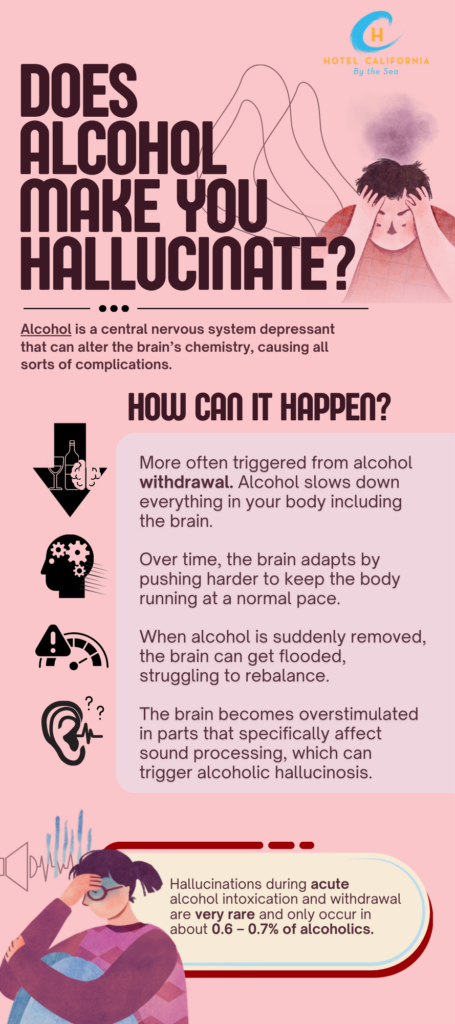
According to the US National Library of Medicine, hallucinations during acute alcohol intoxication and withdrawal are very rare and only occur in about 0.6 – 0.7% of alcoholics.
What is a Hallucination?
A hallucination is a sensory experience that can feel completely real but is made up entirely by your brain. You can see, hear or feel something that has no relation to the outside reality. It’s more than having your eyes play tricks on you after a couple of drinks.
Auditory hallucinations are common. It is when people hear sounds and voices that feel real but are not really there.
Tactile hallucinations are the sensations of feeling that something is physically there when in reality it is not.
Visual hallucinations involve seeing things that are not there or not happening in reality.
Hallucinations differ from the vivid and often bizarre dreams some people experience after drinking. Alcohol can disrupt sleep and lead to intense nightmares. These all happen while you are sleeping. Dangerous hallucinations associated with alcohol that occur while a person is awake is a sign that there is a serious problem.
Alcoholic Hallucinosis: When you start hearing voices
When the brain becomes overstimulated in parts that specifically affect sound processing, it can trigger alcoholic hallucinosis. It is a specific type of alcohol-induced psychotic disorder in which a person begins to hear things that aren’t real. It typically occurs during severe alcohol withdrawal within 12 to 72 hours after heavy drinking has significantly been cut back or stopped entirely.
The most defining characteristic of this condition is that the hallucinations are almost always auditory. Some people might hear voices, commands or random noises like clicking or music. What makes alcoholic hallucinosis particularly worrying is that the person is often completely lucid while experiencing these symptoms. They are not confused about who or where they are and most times recognize that the sounds aren’t real.
Symptoms of this condition can vary from person to person and can also vary in severity and duration. It can last from a few days to a few weeks.
Alcoholic Hallucinosis is triggered by Withdrawal
Alcohol related hallucinations are never usually caused by the act of being drunk. It is more often a symptom of alcohol withdrawal, when a person’s body has become dependent on the substance after prolonged and heavy use.
Alcohol is a depressant that slows down everything in your body including your brain. Over time, the brain adapts to this constant braking by pushing harder on other aspects of internal functioning to keep the body running at a normal pace. When alcohol is suddenly removed, the brain can get flooded with overstimulation and struggle to rebalance itself.
This is when withdrawal symptoms occur. The brain can go into a state of severe hyperactivity and chaos. This is why alcohol withdrawal can cause hallucinations. Extreme hallucinations generate overstimulation and false sensory signals. It can create vivid sights, sounds and feelings that are not real.
Most often, the brain’s hypersensitivity targets the auditory centers, leading to alcoholic hallucinosis that affects a person’s hearing.
Check Your Insurance Coverage for FREE
Find out if your insurance covers addiction treatment in minutes. We accept most insurance!
Delirium Tremens: Another sign of severe Alcohol Withdrawal
Delirium Tremens (DT) occurs at the most severe stage of alcohol withdrawal. It only affects a very small percentage of people experiencing withdrawal. It is life-threatening and requires immediate medical attention. DT can develop within 2-5 days after someone has stopped heavy drinking.
DT involves intense confusion and disorientation. This can cause physical symptoms such as a racing heart, high blood pressure, fever and severe tremors. A person in this state will likely not know where they are or what is happening. Other common symptoms of DT include confusion, irritability, agitation, shaking and seizures.
Hallucinations during DT are different and often more intense. DTs are notorious for causing tactile hallucinations. A common symptom is the sensation of insects or spiders crawling on or under the skin. DT can be fatal without medication intervention.
What is the Difference between Alcoholic Hallucinosis vs DT
- Both are extreme conditions that occur after the abrupt cessation of alcohol use
- Both share symptoms of hallucinations and are complex medical conditions
- Alcoholic hallucinosis most often develops soon after someone has stopped drinking and can last anywhere from a few days to a few weeks
- DT occurs 2-5 days later and symptoms can progressively get worse
- During alcoholic hallucinosis, users are typically aware that their hallucinations are not real
- During DT, users can become extremely distressed and are unable to distinguish between what is happening in their heads and reality
- Alcoholic hallucinosis usually only impacts a person psychologically
- DT includes severe physical and psychological symptoms
- DT is considered a medical emergency, while alcoholic hallucinosis can be treated at home or with general medical care
While Alcoholic hallucinosis is a serious condition requiring medical evaluation, the combination of total confusion and severe physical distress seen in the DTs signals a life-threatening emergency.
Alcoholic Hallucinosis vs Alcohol-Induced Psychosis
Alcohol induced psychosis is a mental health condition characterized by the dissociation from reality, where a user experiences hallucinations, delusions and disordered thinking. It is a direct result of heavy and intense alcohol consumption.
Users will see or hear things that aren’t really there. They will have strong beliefs that are not based in reality. And they will experience excessive and irrational distrust and suspicion of everything.
While both hallucinosis and psychosis occur during alcohol withdrawal and chronic alcohol abuse, alcohol related psychosis also includes symptoms of delusions and paranoia.
Reach out to Hotel California by the Sea
We specialize in treating addiction and other co-occurring disorders, such as PTSD. Our Admissions specialists are available to walk you through the best options for treating your addiction.
Treatment for Alcohol Addiction
Hallucinations aren’t a side effect of being drunk, but are a cautionary signal of alcohol withdrawal. When the brain has been on cruise control for so long and is suddenly thrown onto a busy freeway, it can send overstimulating signals, causing withdrawal. Alcoholic hallucinosis is a symptom of alcohol withdrawal that can lead to the experience of questionable auditory hallucinations.
Professional behavioral treatment programs like Hotel California by the Sea provides help for those struggling with alcohol use disorder. We offer treatment at all levels of care including detox, residential, PHP and IOP. We utilize evidence-based methods such as CBT, DBT and group therapy. Hotel California by The Sea is dedicated to helping our clients reach their goals in sobriety and overcome their addiction.
References:
https://rehabclinicsgroup.com/alcohol-hallucinosis-vs-delirium-tremens
https://futuresrecoveryhealthcare.com/blog/alcohol-hallucinations/
https://universitybehavioral.com/blog/link-between-alcohol-and-psychosis/
https://pmc.ncbi.nlm.nih.gov/articles/PMC3830167