
Dissociative Drugs
Dissociative drugs are known for making people feel separated from reality, their bodies and their environment. The feeling is often described as being far away from your body, being in a dreamlike state and time stretching out in fragments. But it isn’t all fun, games and trippy sensations. Dissociative drugs can carry serious medical risks, mental health consequences and sometimes other clinical issues.

There is a current growing trend in the study of dissociative drugs for treating mental health disorders such as depression, anxiety, PTSD and chronic pain. There are currently two dissociative drugs that are FDA-approved: Ketamine and Esketamine. The FDA has also granted breakthrough therapy designation for two different formulations of psilocybin to be studied for its impact on mental health conditions.
Many dissociative drugs are derived from plants or fungi. These types have been used for thousands of years as part of traditions or religious rituals. Others are synthetically made and used for seeking out new, fun and healing experiences. In other words, for recreational use.
There is some evidence that shows people who consistently use dissociative drugs can develop a tolerance and dependence, resulting in having to consume larger and more frequent doses. This is a psychological or physical dependence on the drug. When dependence develops, it is much easier for an addiction to grow.
What are Dissociative Drugs
A simple definition of dissociative drugs: dissociative drugs are substances that can disrupt the brain’s normal processing for perceptions, memory, emotion and body awareness. It impacts how people see their reality by feeling disconnected from their physical body and the physical environment around them.
Dissociation and depersonalization: Dissociation is a sense of disconnection. Depersonalization is feeling unreal or detached from your body or identity. It is as if you are watching yourself from the outside.
Dissociative disorders. These are mental health conditions where dissociation happens as a symptom of using these types of drugs. It can be linked to trauma, stress or other factors.
How do Dissociative Drugs work?
Dissociative drugs primarily affect how the brain processes the chemical glutamate by blocking NMDA receptors. Glutamate is an important communication chemical in the brain and when the NMDA receptors are disrupted, the brain can mishandle sensory input, pain signals and memory formation. It affects the balance of glutamate in the brain.
This causes a person’s perception to be distorted. It causes the pain sensitivity in the body to drop. It impairs coordination and judgment. It impairs memory and emotion. And it can make a person’s mind feel separated from the body.
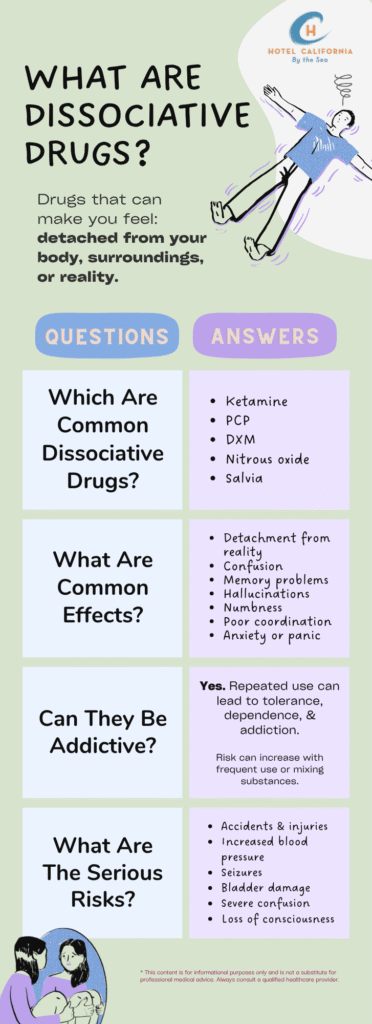
Dissociative Drugs List
- Ketamine. Ketamine is a medical anesthetic and chemical compound that can be found in prescription medications. It can be legally manufactured in liquid form or an off-white powder. It produces dissociative anesthetic effects often used in surgery. Side effects include amnesia and analgesic pain relief. Low doses of ketamine can produce stimulant effects while higher doses produce dissociative, out-of-body experiences.
- Phencyclidine (PCP). PCP is a drug that produces both hallucinogenic and dissociative properties. It was developed in the 1950s as an intravenous anesthetic. It is often sold on the illicit market as a tablet, pill or colored powder. It can be snorted, smoked, or orally ingested, with the effects lasting anywhere from 4 to 6 hours.
- Dextromethorphan (DXM). DXM is an ingredient often found in cough suppressants and expectorants, which are sold over the counter.
- Nitrous Oxide. Also known as laughing gas, nitrous oxide is a dissociative anesthetic found to produce distorted perceptions and sometimes visual hallucinations.
- Salvia Divinorum. Salvia is derived from a psychoactive plant that grows in Southern Mexico, Central and South America. It is ingested by chewing on the leaves or drinking a tea made from the leaves. It can also be ingested through smoking or vaping.
- Methoxetamine. This substance is derived from ketamine and can produce longer-lasting and more powerful effects.
Dissociative Drug Effects
The effects of dissociative drugs can vary by dose, setting and person. Each experience will be different from the next. No matter how many times you may use the same drug, the effects and experience will always be different. This is the unpredictable nature of dissociative drugs.
Physical Effects:
- Numbness or reduced pain
- Dizziness, vomiting, nausea and sweating
- Slurred speech and uncoordinated body movements
- Increased blood pressure
- Accident or injury due to poor condition and disorientation
- Bladder damage
Mental and Perceptual Effects:
- Dreamlike state of being and detachment from the body
- Visual and auditory hallucinations and distortions
- Confusion, distorted perception of time and memory impairment
- Anxiety, fear and panic
- Depression and suicidal ideation
- Social withdrawal
- Euphoria
Check Your Insurance Coverage for FREE
Find out if your insurance covers addiction treatment in minutes. We accept most insurance!
Are Dissociative Drugs addictive?
Dissociative drugs can be addictive. But not everyone who uses them becomes dependent. However, repeated use can lead to tolerance, dependence and eventually addiction. Dissociative drugs produce unpredictable effects and generally produce a depressant-like effect, which includes drowsiness and pain relief. This is often a desired effect for those who turn to substances.
The risk of addiction rises with frequency of use, higher doses, mixing in other substances and using the drugs to cope with depression, trauma or difficult feelings.
Dissociative Drugs for Mental Health and Addiction Treatment
Recently, there has been some evidence showing that psychedelic and dissociative drugs can help temporarily alter a person’s mood, thoughts and perceptions enough to provide emotional relief. The emotional relief is what many who suffer from treatment-resistant depression, anxiety, trauma and substance addiction often seek in recovery.
It can induce strong emotions that range from extreme happiness to fear and confusion. While some studies and clinical trials have shown promising results, additional research is needed to determine the safety, efficacy and dosing of dissociative drugs for treating mental health and addiction disorders. Evidence so far suggests minimal negative health effects from supervised therapy sessions.
Dissociative Drug Overdose Signs
In most cases, dissociative drugs are used recreationally. Overdose from these substances isn’t always just stopped breathing. It can be a medical crisis, a dangerous behavior or a combination of the two events.
Signs of overdose include:
- Unconsciousness or inability to wake
- Slow, irregular breathing with bluish lips and skin
- Repeated vomiting and inability to sit up safely, causing a choking risk
- Seizures, overheating, chest pain or extreme agitation
- Intense confusion
Reach out to Hotel California by the Sea
We specialize in treating addiction and other co-occurring disorders, such as PTSD. Our Admissions specialists are available to walk you through the best options for treating your addiction.
Treatment for Substance Use Disorder
Dissociative drugs can feel like a shortcut out of pain, whether it is physical or emotional. The out-of-body experience may be enticing, but it comes with tradeoffs of mental health destabilization and real medical risks. Knowing what dissociative drugs are and how dissociative drugs work on NMDA receptors can make a difference between a temporary experience and long-term harm.
Hotel California by the Sea provides substance use recovery treatments for psychedelic and dissociative drugs. We offer treatment at all levels of care including detox, residential, PHP and IOP. We utilize evidence-based methods such as CBT, DBT, and group therapy. Hotel California by the Sea is dedicated to helping clients reach their goals in sobriety and overcome their addiction.
References:
https://nida.nih.gov/research-topics/psychedelic-dissociative-drugs
https://nida.nih.gov/research-topics/psychedelic-dissociative-drugs-medicines
https://rehabs.com/drugs/hallucinogens-dissociatives
https://adf.org.au/drug-facts/dissociatives