
LSD Effects: How long does Acid take to hit?
Acid, or lysergic acid diethylamide (LSD), is a hallucinogenic substance that can temporarily alter a person’s mental state. If you are wondering how long does acid take to hit, in general, the effects of the substance can take effect between 20 and 90 minutes after ingestion. The strongest effects of the drug commonly build over the following few hours.

When taking LSD, the experience is referred to as an acid trip. During the trip, thoughts, moods, senses and perception of reality can change. It is a powerful substance that only takes a small amount to produce effects. The synthetically made drug was developed from a substance found in ergot, which is a fungus that grows on rye and grains. The synthetic drug has a similar chemical structure to serotonin.
What is LSD?
Acid is an illegal substance in the US. It is a Schedule I controlled substance with no medical benefits. It is not regulated for safety or potency. It is colorless, odorless and typically found in liquid form where it is dabbed onto an absorbent blotter paper. Each blotter square is called a tab and usually contains enough of the substance to produce a single trip.
Acid is not considered an addictive substance and is considered a non-toxic drug when taken in a standard dose. However, because of the manufacturing process and the regulatory process in which it is made, there is no definitive way of measuring how potent a dose may be. LSD toxicity is rare. Users are more likely to experience a bad trip. Though not chemically addictive, users can develop a psychological dependence and build up a tolerance to the drug.
How long does Acid take to hit
For most people, acid starts to hit within about 20 to 60 minutes after it is taken orally. But depending on various factors, there is a possible wider onset window. When taken orally, once the drug is metabolized and absorbed into the gastrointestinal system, it will then travel to the bloodstream and then to your brain.
If the drug is taken through an intravenous injection, the onset of effects can be almost immediate. If taken intramuscularly, the effects will kick in at about the 15-minute mark.
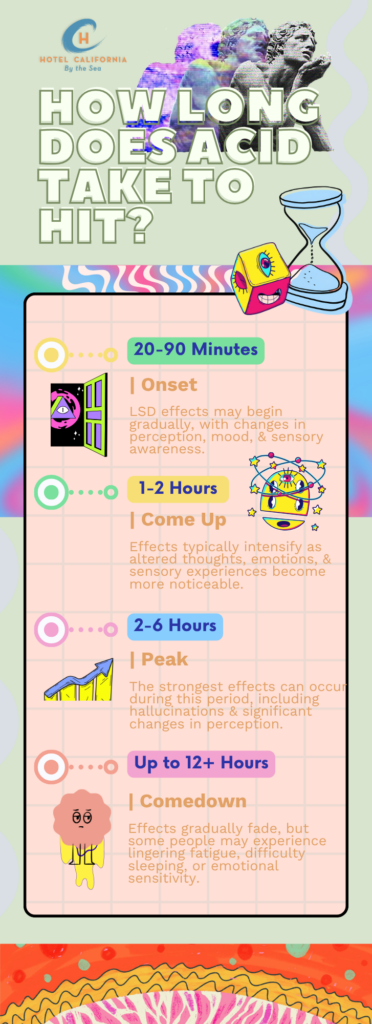
Acid tends to hit people in phases rather than an instant switch. LSD often begins quietly and intensifies over time, reaching its peak and then fading away slowly.
Once a trip starts, peak effects are felt around 2 to 4 hours and can last anywhere from 10 to 12 hours. Most trips don’t last more than 12 hours. The duration of the trip depends on drug purity, drug dose and the individual metabolism of the person. Between the initial trip and the comedown, it can take up to 24 hours for the brain and body to return to a normal state.
Factors that impact how long it takes for Acid to hit
- Method of administration. LSD is often taken orally on blotter paper, tablets, sugar cubes or liquid. Absorption of the drug is different depending on how it is taken, whether it is swallowed quickly and what else is in the stomach. Even with the same route of ingestion, one person can feel the effects earlier than another person.
- Dosage and potency. A stronger dose can make the effects hit harder and faster, but potency can be difficult to measure. Unregulated products or often mislabeled or substituted with other ingredients, leaving users without definitive knowledge of the potency of the product.
- Food, body chemistry and mindset. A full stomach may make the onset of effects much slower. Fatigue, stress and environment also impact the acid trip. LSD affects perception and emotion so the same physical timeline can feel endless, gentle or sudden depending on the person’s mental state.
- Other substances. The presence of other substances like alcohol, stimulants, dissociatives, antidepressants and other drugs can change the experience and risk profile when taking LSD.
LSD Timeline
The exact timeline for an acid trip can vary. Unknown blotter, liquid or tablets can contain varying amounts of LSD or even entirely different substances.
The initial onset. This starts between 20 and 60 minutes in. Changes can include sensory sensitivity, shifts in body temperature, stomach discomfort, nervousness and unusual thought patterns.
The come up. Between 1 and 2 hours, there is a gradual intensifying of changes in mood, energy and senses. The effects can become clearer, with visual distortions, emotional intensity, and altered perception of time increasing.
The peak. Between 4 and 6 hours is considered the peak window when effects are the strongest for many people. Users can experience intense psychedelic effects including hallucinations and altered sensory perceptions.
The plateau. Up to 8 hours, the experience of the trip can remain intense but gradually become more manageable.
The comedown. During the comedown phase, the effects will begin to fade while remaining stimulation and emotional sensitivity can linger.
The afterglow. During the last phase of an acid trip, it can take anywhere from hours to days for the drug effects to fully wear off. Users can experience tiredness, insomnia, confusion, or mental residue as psychological effects slowly fade.
Check Your Insurance Coverage for FREE
Find out if your insurance covers addiction treatment in minutes. We accept most insurance!
Symptoms and effects of an Acid trip
Acid trips are different for each person and even each time the same person uses LSD. For most people, 1 to 3mg of LSD is enough to produce a moderate trip. However, it can be difficult to discern how much one dose is due to no regulations in the manufacturing of the illicit substance.
In some cases, LSD can lead to a good trip that consists of intense feelings of pleasure, enlightenment, happiness and connection to others. A bad trip can leave users feeling scared and confused with hallucinations that leave you feeling distraught and terrible.
- Visual distortions: unnaturally bright colors, swirling patterns, bright halos above objects, changes in shapes or noisy colors
- Sensory changes: seeing taste or smelling colors
- Hallucinations: seeing, hearing, feeling or tasting things that are not really there
- Mood changes: intense feelings of connection, affection, or feelings of paranoia and anger
- Physical changes: increased heart rate, high blood pressure, sweating, nausea, dry mouth and insomnia
- Tolerance: tolerance can develop with repeated acid use, where larger doses are needed in order to achieve the same effects
- Flashbacks: hallucinogen persisting perception disorder is rare nd casues sensory disturbances similar to an acid trip
- Drug-induced schizophrenia: LSD can trigger schizophrenia is people who may be predisposed to the condition
Mental Health considerations associated with LSD
LSD can produce intense psychological effects and not every difficult reaction is harmless. Some people with a personal or family history of psychosis, schizophrenia or severe anxiety disorder may have higher risks when it comes to using psychedelics. Recurring use of acid can lead to drug-induced panic, perceptual disturbance and other mental illness conditions.
Reach out to Hotel California by the Sea
We specialize in treating addiction and other co-occurring disorders, such as PTSD. Our Admissions specialists are available to walk you through the best options for treating your addiction.
Treatment for Substance Use Disorder
So how long does it take for acid to hit? The short answer is around 20 to 90 minutes. However, each person experiences an acid trip differently. With repeated use, LSD can become psychologically addictive. Hotel California by the Sea provides supportive programs for those struggling with LSD dependence and addiction. We offer treatment at all levels of care including detox, residential, PHP and IOP. We utilize evidence-based methods such as CBT, DBT and group therapy. Hotel California by the Sea is dedicated to helping clients reach their goals in sobriety and overcome their addiction.
References:
https://www.medicalnewstoday.com/articles/what-does-acid-feel-like
https://www.recoveryunplugged.com/how-long-does-acid-last/
https://www.alinalodge.org/addiction-treatment/how-long-does-acid-stay-in-your-system/
https://www.healthline.com/health/how-long-does-acid-last