
What is Gray Area Drinking?
Gray area drinking is a recently coined term to describe potentially problematic drinking that doesn’t necessarily lead to dependence or addiction. This type of drinking encompasses problematic drinking behaviors that fall between social drinking and severe alcohol use disorder. It is when someone consumes alcohol in a way that is problematic but doesn’t actually fit the criteria for someone with a severe alcohol addiction.

Many believe the term describes the fine line between social drinking and alcoholism. A “gray area” with blurred boundaries between moderate to severe alcohol consumption. Recent research found that as many as 25% of Americans can now be categorized as gray area drinkers. Gray area drinking is not an official medical diagnosis.
Alcohol use is normalized in our culture. Gray area drinking can make it more difficult to know when you are crossing the line into alcohol addiction. Some gray area drinkers may develop early signs of alcohol use disorder. But it doesn’t mean that a person has an addiction to alcohol.
History of the term Gray Area Drinking
The concept of gray area drinking was first introduced and popularized by functional nutritionist Jolene Park at her 2017 TED Talk. She described it as the kind of drinking where you don’t necessarily hit rock bottom, but you continue to drink as a way to manage anxiety, all while regretting how much and how often you drink. It is an umbrella term to describe different behaviors related to alcohol consumption. Drinking behaviors include social drinking, problematic drinking, heavy episodic drinking and regular but moderate drinking.
When the pandemic hit, the lack of social interactions naturally led to more people drinking at home. With the additional stressors of 24-hour home life, it was easy to go from one glass of wine to another. This pattern of drinking began fueling what we consider to be gray area drinking.
Who are Gray Area Drinkers?
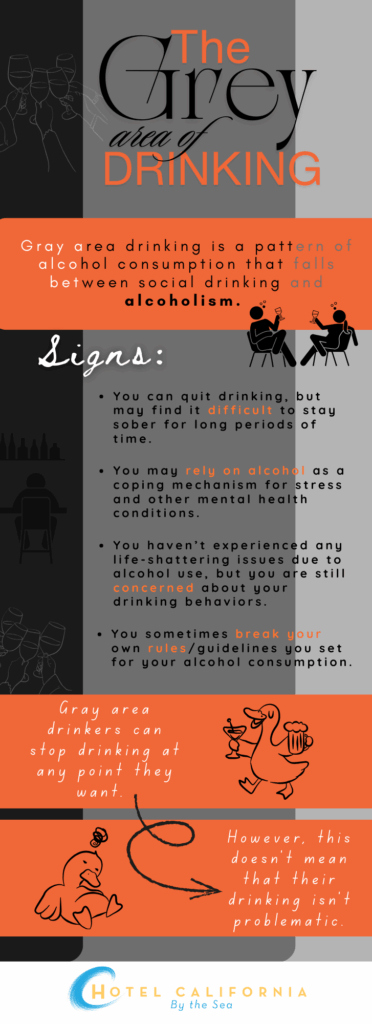
Gray area drinkers don’t identify with alcohol use disorder because they can stop drinking at any point they want. However, this doesn’t mean that their drinking isn’t problematic. Gray area drinkers sometimes think of themselves as social drinkers, but do question how social their drinking is when they start drinking alone.
Gray area drinkers do not have a dependency on alcohol. They continue to drink simply because they want to and not because they want to avoid any withdrawal symptoms that can occur with those who have become physically dependent on the drug.
Gray area drinkers are usually aware that, for the most part, their drinking habits do not align with social norms and could be a cause for concern regarding risks to their health, relationships and career. However, most gray area drinkers have taken their own initiative to reduce their drinking by setting limits or engaging in healthier activities. Their drinking can be controlled without professional treatment.
Some gray area drinkers may be dealing with a major life crisis or life changes. This puts them at high risk of stress and depression. In turn, gray area drinking can start off as a coping mechanism as a way to manage difficult emotions.
Signs you have a Gray Area Drinking problem
- You can quit drinking, but you find it difficult to stay sober for long periods of time. You might find yourself drinking again in a few weeks or months after you have stopped.
- You haven’t experienced any life-shattering problems due to alcohol use, but in the back of your mind, you are still concerned about your drinking behaviors.
- Your drinking doesn’t seem problematic to those around you, but you notice that you are drinking regularly and often.
- Sometimes you have a nagging voice in your conscious telling you to drink less and you go back and forth between listening to your conscious and then telling yourself it’s no big deal.
- You experience anxiety about your drinking. You become consumed with your drinking habits, where you anticipate the next drink and wonder if your habits have gotten out of control. You might even experience hangxiety. Hangxiety is a phenomenon in which you experience a physical hangover with nausea and vomiting in combination with anxiety that occurs due to drops in dopamine levels in the brain.
- You may rely on alcohol as a coping mechanism for stress and other mental health conditions.
- You sometimes break your own rules and established guidelines you set for your own alcohol consumption.
- You start having relationship issues due to heightened temper and arguments resulting from problematic drinking.
- You begin feeling guilt or shame about how much you drink and sometimes forget how much you drink.
Check Your Insurance Coverage for FREE
Find out if your insurance covers addiction treatment in minutes. We accept most insurance!
Symptoms and Side Effects of Gray Area Drinking
- Difficulty staying abstinent. Alternating between heavy periods of drinking and abstaining from drinking. Users find it difficult to maintain long-term sobriety.
- Lack of recognition. Users do not show clear signs of a drinking problem and can appear normal to everyone around them. This can make it difficult to identify the level of alcohol use.
- Experiencing the internal tension that can cause a cycle of drinking and cutting back.
- Many people worry about their drinking habits for years before actually acting on them. They can be hesitant to seek out help and the struggle may cause stress and anxiety.
- It can cause hidden concerns about your alcohol habits.
- It can negatively impact different parts of your life, like relationships, work performance, and physical health.
How to manage and reduce the risk of Gray Area Drinking
Reducing the risk for gray area drinking requires both a physical and mental health approach. Recognize the patterns of gray area drinking. Know the signs to look for. Self-reflect and consider why you are drinking. Have you ever used alcohol to help you cope? Take into consideration the mental and emotional state of being when you are gray area drinking. Once you have become educated on the signs and symptoms, it can be easier to work towards preventing them.
- Consider the circumstances in which you drink and make a pros and cons list
- Drink mindfully
- Consider taking time off from drinking
- Find alternative stress management tools
- Learn a new skill or hobby to keep you busy and focus on activities that naturally increase your dopamine levels
- Spend more time in nature
- Prioritize face-to-face relationships
- Eat nutritious foods
Reach out to Hotel California by the Sea
We specialize in treating addiction and other co-occurring disorders, such as PTSD. Our Admissions specialists are available to walk you through the best options for treating your addiction.
Treatment for Alcohol Use Disorder
Gray area drinking is a pattern of alcohol consumption that falls between social drinking and alcoholism. The unclear region that borders causal social drinking to potentially dangerous habits can make people unaware of the hidden dangers of this type of drinking habit. It begs the question, what is an acceptable level of alcohol consumption?
Gray area drinking is not a topic discussed enough among friends and families and it is often hidden. And because it is often hidden and pushed under the rug, it can also be more difficult to identify and treat compared to a full-blown alcohol use disorder.
Professional treatment programs like Hotel California by the Sea provide alcohol addiction treatments. We offer treatment at all levels of care including detox, residential, PHP and IOP. We utilize evidence-based treatment methods such as CBT, DBT and EMDR therapy. Hotel California by the Sea is dedicated to helping clients reach their goals in sobriety and overcome their alcohol addiction.
References:
https://www.hanleycenter.org/what-is-gray-area-drinking
https://www.psychologytoday.com/us/blog/a-fine-line/202204/what-is-gray-area-drinking
https://stjosephinstitute.com/blog/gray-area-drinking-quiz
https://www.healthcentral.com/substance-abuse-and-addiction/gray-area-drinking
https://riahealth.com/blog/what-is-gray-area-drinking
https://www.womensrecovery.com/womens-rehab-blog/what-is-grey-area-drinking/