
How long does Clonidine last in your system?
Clonidine is a prescription medication often used in the treatment of opioid withdrawal. It works by minimizing the effects of opioid withdrawal symptoms such as anxiety, agitation, muscle and joint pain, sweating and abdominal cramps. ‘How long does clonidine last in your system?’ is what many are often curious to know before taking on the medication for their opioid use disorder. On average, it can take about 3 days for clonidine to be completely removed from the system.
However, there are many different factors that can impact the elimination time. Factors such as medication dosage, kidney function and health and other medical history can dictate how quickly or slowly clonidine lasts in the body.
Clonidine is not a scheduled drug and therefore is not heavily restricted. It is easier to obtain and in some cases, easier to misuse, compared to other sedative-type drugs. When used for a long period of time, or when used in heavy doses, clonidine can lead to an increased risk of tolerance and withdrawal.
What is clonidine and how does it work?
Clonidine was FDA-approved in 1974 as a centrally acting adrenergic blocker and is used in the treatment of hypertension and other symptoms of high blood pressure. It is also often used off-label to help treat withdrawal symptoms in opioid use disorder treatment.
Clonidine is available in two main formats: tablet or patch. The tablet is usually taken every few hours on the first day of taking the medication. The next several days will be adjusted depending on withdrawal symptoms that are experienced. The patch form can take up to a few days to reach a steady state. Both administrations of the drug require supervision from a health care professional.
This antihypertensive medication works by blocking the chemicals in the brain that trigger sympathetic nervous system activity. It reduces the number of signals that cause blood vessels to tighten. This impacts the central nervous system and helps to lower blood pressure.
Clonidine for Opioid Withdrawal
Clonidine is often used for the treatment of opioid withdrawal symptoms and for treating withdrawal from other substances like benzodiazepines and alcohol. It can help reduce opioid withdrawal symptoms as well as opioid cravings.
Common withdrawal symptoms such as anxiety, sweating, hot flashes and restlessness can all be treated with clonidine. Clonidine is used in about 80% of detox treatment centers, where the detox process can last up to 7 days when on the medication. It can help make the process smoother and more comfortable, leading to increased chances of a full recovery after the initial detox process.
How long does Clonidine last in your system?
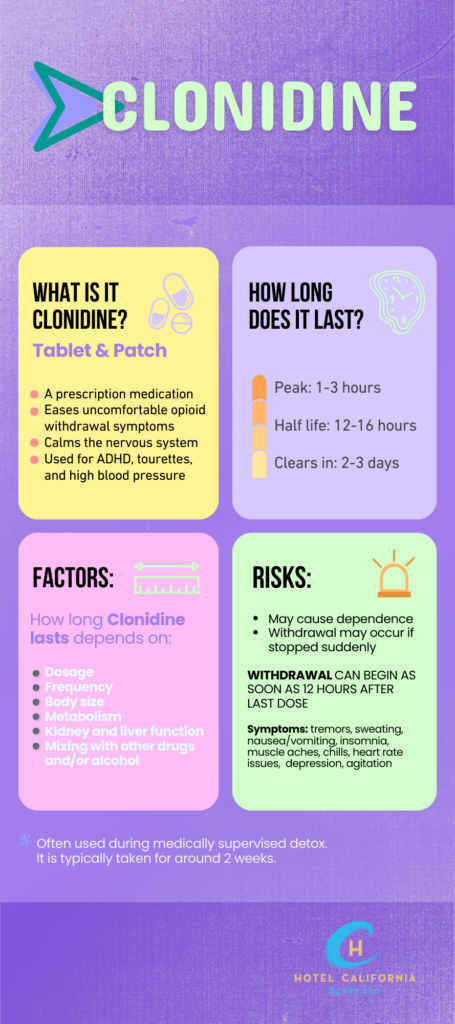
Clonidine has an average half-life of 12-16 hours and can take about 2-3 days for the medication to be fully eliminated from your system. The drug is quickly absorbed into the bloodstream and can reach peak effects within 1-3 hours. Its effectiveness can last up to 12-16 hours after drug administration.
Immediate-release formulations can go into effect within 30-60 minutes, with peak effects around 2 hours, and can last between 1-5 hours. Extended-release formulations of the drug don’t take effect until about 5 hours in.
However, there are many different factors that play a role in how long clonidine lasts in the system.
- Formulation of the medication (extended release or immediate release)
- Dosage
- How often medication is taken
- Height, weight and body mass – Larger people process medication differently than smaller people. Size and fat content can impact how quickly our body eliminates the drug.
- Individual metabolic rate
- Hydration
- Reasons for taking the medication
- If the user is physically active
- Kidney function and health – This organ helps eliminate the drug through urine.
- Liver function and health – The medication is broken down in the liver.
- Drug and alcohol use
- Gender
- Age – The body processes medication more slowly as you begin to age.
- Other underlying medical conditions
- Other medications – If you are taking other medications that impact your liver enzymes and kidney function, it can make the elimination process slower.
Check Your Insurance Coverage for FREE
Find out if your insurance covers addiction treatment in minutes. We accept most insurance!
Signs that Clonidine is still in your system
- Drowsiness
- Dizziness
- Dry mouth
- Low blood pressure
- Slow heart rate
- Overdose – If it stays in your system for too long, it can lead to respiratory depression and your breathing begins to slow down to a point where it can completely stop.
Clonidine Misuse, Withdrawal and Addiction
Clonidine is not classified as having high abuse potential. This means there are fewer restrictions on the drug and it is often used in medication-assistance treatments for opioid use disorder and alcohol withdrawal treatment. It is typically taken for around 2 weeks. It can also be prescribed for a longer period of time, between 2 and 4 months.
Misuse of clonidine is not uncommon. Its ease of availability and its common use for the treatment of withdrawal symptoms can turn this drug into a long-term use medication. In the majority of cases, misuse of clonidine often starts at substance addiction rehab centers. This is because of how common practice it is to use for withdrawal treatment.
Clonidine can cause dependence if used over a long period of time or if used in high doses. It can cause both physical and psychological dependence.
Physical dependence is when the body adapts to the presence of clonidine and eventually will require the substance in order to function normally. Psychological dependence happens when someone develops an emotional or mental resilience to clonidine. This means the person could begin experiencing anxiety, depression and other negative emotions when they are not using the drug or it is not in their system.
Dependence often leads to the development of withdrawal symptoms if a person attempts to stop or reduce drug use. Withdrawal can begin as soon as 12 hours after the last dose and can last up to several weeks. Common withdrawal symptoms include nervousness, agitation, insomnia, headaches, shaking or tremors, sweating, nausea and vomiting, chills, muscle aches, depression, rebound high blood pressure, rapid heart rate and palpitations.
What does Clonidine Misuse look like?
- Occasional non-prescription use – When using clonidine recreationally without a prescription
- Unapproved doses – When using clonidine in a way other than prescribed, such as a higher frequency of dose or a higher quantity of dose
- Using with other substances – When clonidine is used with other substances, it can enhance the effects or reduce the side effects of the other substance
- Self-medication – When using clonidine to help manage self-diagnosed conditions that the medication was not approved to treat
Side Effects of Clonidine Misuse
- Extremely low blood pressure
- Abnormally slow heart rate
- Reduced blood flow to the brain, which can cause fainting
- Severe drowsiness
- Confusion or disorientation
- Depression and other mood changes
- Hallucinations
- Slowed breathing and difficulty breathing
- Chronic hypertension
- Changes in appetite
- Sleep disorders
- Difficulty with memory and concentration
Reach out to Hotel California by the Sea
We specialize in treating addiction and other co-occurring disorders, such as PTSD. Our Admissions specialists are available to walk you through the best options for treating your addiction.
Treatment for Substance Use Disorder
Clonidine is a popular medication used to help ease opioid withdrawal symptoms and is commonly used as a part of MAT. Though it is not a scheduled substance, there is a potential for dependence and addiction to the medication.
Professional behavioral health treatment programs like Hotel California by the Sea provide support for clients at all levels of care including detox, residential, PHP and IOP. We utilize evidence-based methods such as CBT, DBT and MAT. Hotel California by the sea is dedicated to helping clients reach their goals in recovery and overcome their addiction.
References:
https://www.addictioncenter.com/treatment/medications/clonidine
https://atlasbehavioralhealth.com/how-long-does-clonidine-stay-in-your-system/
https://rehabnet.com/prescription-drugs/clonidine/
https://www.ncbi.nlm.nih.gov/books/NBK459124
https://www.methadonecenters.com/how-long-does-clonidine-stay-in-your-system
https://addictionresource.com/drugs/clonidine/how-long-stays-in-system