
Ambien vs Lunesta
What do people turn to when they have insomnia? Ambien and Lunesta are both non-benzodiazepine prescription medications used to treat symptoms of insomnia. What is the difference between Ambien vs Lunesta? Which one is more effective? Which medication lasts longer? These are all questions to consider when finding a treatment medication that will work best for you.
Ambien and Lunesta are sedative hypnotic substances that both require a prescription and are classified as a Schedule IV controlled substance. This is because both have boxed warning labels and have been linked to dangerous side effects, which can lead to dependence, abuse and addiction.

Melatonin is another commonly used supplement to help in the treatment of sleep disorders and sleep problems. However, melatonin supplements are completely different from prescription medications such as Ambien and Lunesta. It works differently and for a different purpose.
What is Insomnia?
Insomnia is characterized by difficulty falling asleep or staying asleep for at least three nights a week. Daytime symptoms of insomnia can include drowsiness, difficulty concentrating and irritability, all due to lack of sleep. There are two main types of insomnia.
Chronic insomnia is a condition that occurs for more than three months. Short-term insomnia occurs for less than three months and is often linked to a particular stressor that recently happened. Both conditions can make it difficult to fall asleep and difficult to stay asleep.
There are many factors that increase the risk of developing insomnia.
- Sleep apnea
- Stress
- Dietary deficiencies
- Older age
- Having a family history of insomnia
- Working a night shift
- Situational issues like having small children
- Lack of exercise during the day
- Screen time is too close to bedtime
- Depression and anxiety
- Substance abuse
- Any chronic medical conditions
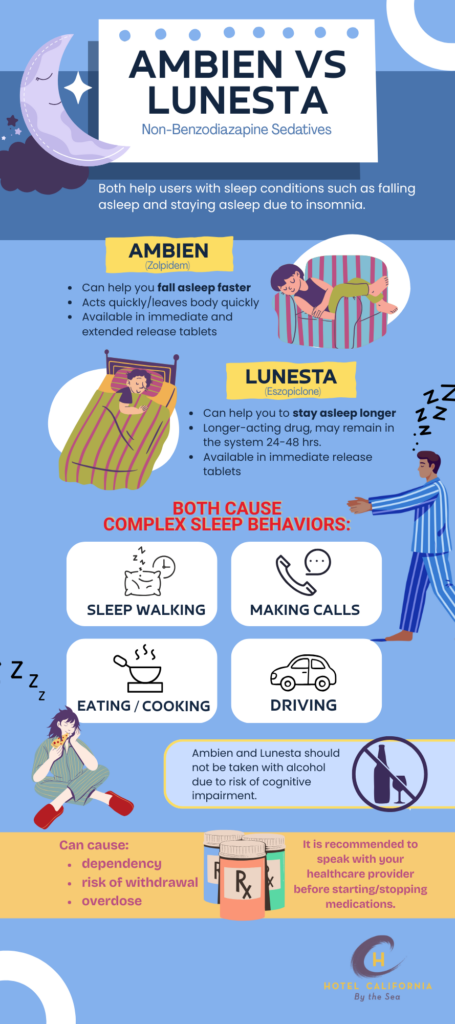
Ambien vs Lunesta
Ambien
- Generic name: zolpidem
- Primarily used for short-term treatment of insomnia
- Non benzo sedative hypnotic in the imidazopyridine class of drugs
- Ambien is available in 5mg and 10mg
- Available in immediate and extended release tablets
- Common side effects – drowsiness, dizziness, diarrhea, the feeling of being drugged, headache and amnesia
- Ambien can help you fall asleep faster
- The effects of Ambien act more quickly, but that also means it leaves the body just as quickly
- Half life of Ambien is about 2.5 hours
Lunesta
- Generic name: eszopiclone
- Primarily used for short-term treatment of insomnia
- Non benzo sedative hypnotic in the cyclopyrrolone class of drugs
- Lunesta is available in 1mg, 2mg and 3mg
- Lunesta is available in immediate-release oral tablets
- Common side effects – headache, drowsiness, dizziness, dry mouth, indigestion, nausea and nervousness
- Lunesta can help you stay asleep longer
- Lunesta is a longer-acting drug and can remain in the system for 24 to 48 hours
- Half life of Lunesta is about 6 hours
The Similarities between Ambien and Lunesta
Both of these medications help users with sleep conditions such as falling asleep and staying asleep due to insomnia. Both medicines can cause next-day impairment and are recommended to be taken with at least 7 to 8 hours left before you need to get up. They are sleep aids that help decrease brain activity and produce a sense of calm.
Ambien and Lunesta can cause complex sleep behaviors. These side effects include sleep driving, sleep walking, cooking, making phone calls and having full-on conversations and performing other activities while not being fully awake and aware of their surroundings. This can be very dangerous to the user as well as others.
Other rare side effects of both drugs include risk of memory loss, behavioral changes, detachment, depression or worsened depression, thoughts of suicide, confusion and hallucinations. The risk of these side effects is increased when they are taken with alcohol or another central nervous system depressant.
Ambien and Lunesta should not be taken with alcohol due to risk of cognitive impairment. This combination of substances often leads to dependence on the drug and can lead to addiction to either substance.
Both medications can cause high dependency, leading to a risk of withdrawal when suddenly stopped or the dosage has decreased significantly. They can cause rebound insomnia, a drop in energy levels, anxiety, depression, headaches, vomiting, difficulty concentrating and dizziness. Stopping the medications abruptly leads to the risk of withdrawal and overdose and it is recommended to speak with your healthcare provider before doing so.
Check Your Insurance Coverage for FREE
Find out if your insurance covers addiction treatment in minutes. We accept most insurance!
How much Melatonin is equal to Ambien?
Melatonin is a hormone that helps to regulate the body’s circadian rhythm. It is naturally produced by the pineal gland and regulates the sleep-wake cycle. It signals the body when it’s time to sleep and wake up. When it gets dark outside, melatonin levels rise, signaling the body to go to sleep. When it becomes daytime, melatonin levels decrease, signaling to the person that it is time to get up. Melatonin is often used to address circadian rhythm disorders such as jet lag and shift work sleep disorders.
It is often sold as a supplement and is available over the counter. It comes in many different formulations such as oral pills, gummies, sprays, skin patches and topical creams.
Melatonin and Ambien are different types of substances with differing mechanisms of action. They cannot really be compared in terms of how much of one substance is equal to another substance. While Ambien works by enhancing the GABA neurotransmitters responsible for calming the nervous system, melatonin works by resetting your body’s internal clock.
Ambien is recommended for those who are experiencing acute insomnia and require immediate relief to fall asleep and should only be used under a healthcare provider’s guidance and supervision. Melatonin is more ideal for people with sleep difficulties related to circadian rhythm disruptions. This includes travelers with jet lag or workers who work night shifts and find it hard to sleep during the day.
Melatonin helps to reset the internal clock, while Ambien is a sedative. Ambien works by inducing sleepiness, while melatonin helps the body to synchronize its sleep-wake cycle with environmental cues.
Melatonin vs Ambien
Melatonin
- Used for the treatment of short-term sleep problems such as delayed sleep wake disorder, jet lag or anxiety surrounding surgery
- It is well tolerated with very few side effects
- It is not habit-forming like other sleep aids
- It is available over the counter and comes in different strengths
- It is available as a low-cost generic
- However, it is not regulated by the FDA, so you might not always be taking the right dose for your treatment
- It is unknown as to whether or not it is safe for long-term use
Ambien
- It works quickly, within 13-30 minutes to help you feel sleepy
- It is available as a low-cost generic
- It comes in multiple strengths
- It should only be used for short-term treatment
- Can cause risk of dangerous nighttime behaviors such as sleep walking, sleep driving or sleep eating
- Risk of withdrawal symptoms includes stomach cramps, sweating and vomiting
- Is a controlled substance with a risk of misuse and dependence
Reach out to Hotel California by the Sea
We specialize in treating addiction and other co-occurring disorders, such as PTSD. Our Admissions specialists are available to walk you through the best options for treating your addiction.
Treatment for Substance Use Disorder
Ambien and Lunesta are popular prescription medications used to treat symptoms of insomnia. Studies have shown that both have very similar effectiveness for treating the sleep disorder. One drug is not more potent than the other and both should be used only under medical supervision. This is due to the high risk of dependence and withdrawal symptoms. When this occurs, it can easily lead to the development of an addiction.
Hotel California by the Sea provides treatment for addiction to sleep aids such as Ambien or Lunesta. We offer treatment at all levels of care including detox, residential, PHP and IOP. We utilzie evidence based treatment methods such as CBT, DBT and MAT. Hotel California by the Sea provides tools, resource and support to clients to help them overcome their addiction.
References:
https://www.drugs.com/medical-answers/lunesta-ambien-how-compare-3578458/
https://www.verywellhealth.com/lunesta-vs-ambien-8675475
https://www.healthline.com/health/healthy-sleep/lunesta-vs-ambien
https://addictionresource.com/drugs/lunesta/vs-ambien
https://www.thesleepreset.com/blog/ambien-vs-melatonin-which-one-is-right-for-you